Iran’s Central Asia Initiative (2020–Present)
Iran’s engagement with Central Asia has accelerated since 2020 as Tehran pursues a multidimensional strategy in the region. This initiative spans economic cooperation, political diplomacy, security partnerships, and cultural outreach with the five post-Soviet Central Asian republics – Kazakhstan, Kyrgyzstan, Tajikistan, Turkmenistan, and Uzbekistan. The following sections examine Iran’s evolving relations with these countries across key domains, highlighting major developments from 2020 to 2025, and critically assess Iran’s strategic aims amid competition with other powers and enduring constraints.
Economic Relations: Trade and Infrastructure
Iran has substantially expanded trade ties with Central Asia since 2020. Bilateral trade volumes have generally risen (with some fluctuations), reflecting Iran’s push to become a trading hub for its landlocked northern neighbors. Figure 1 illustrates the trend in Iran’s annual trade turnover with each Central Asian country from 2020 to 2024, measured in total value of imports and exports.
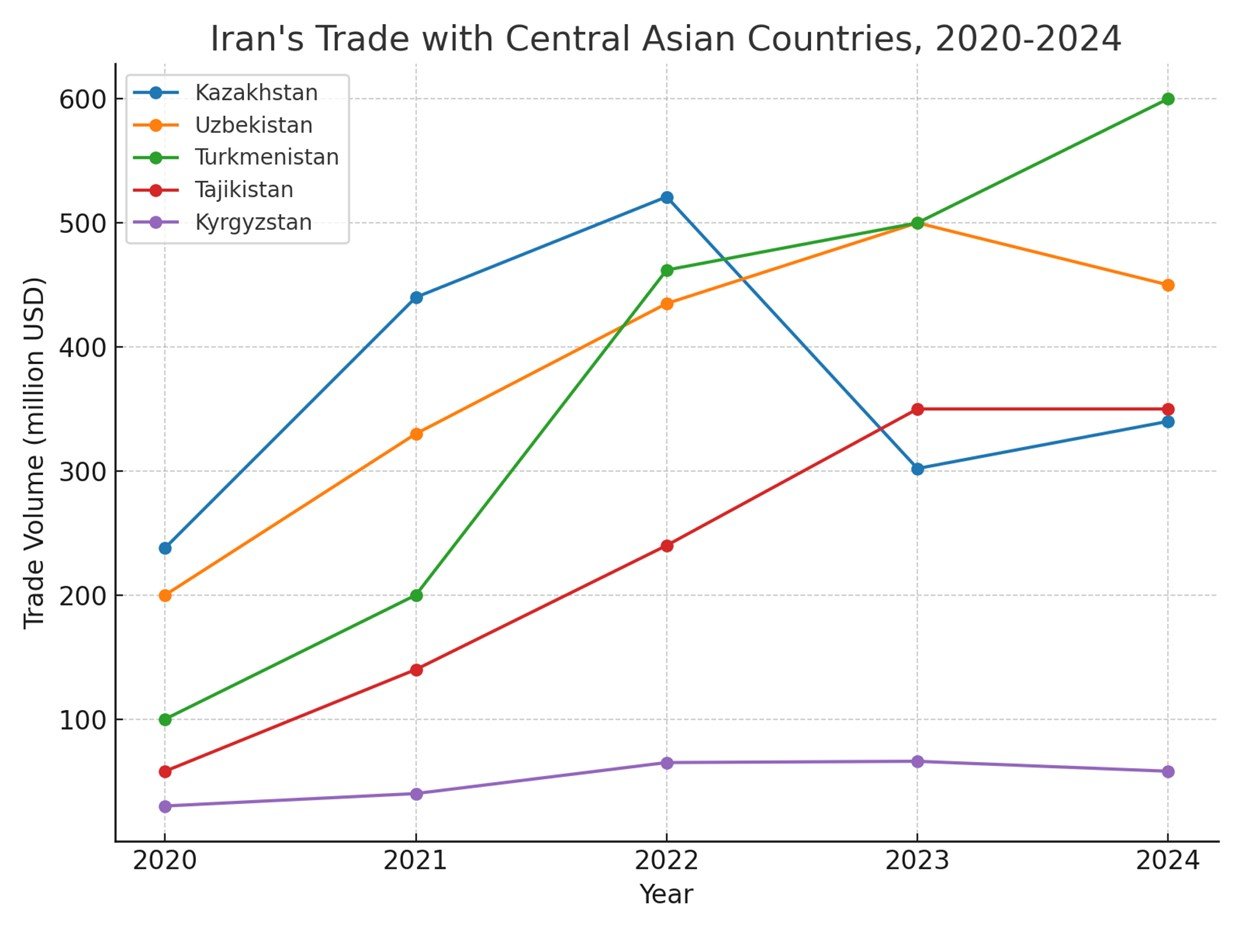
Figure 1: Iran’s Trade with Central Asian Countries, 2020–2024. Trade volumes grew significantly from 2020 to 2022 before some corrections, especially in Iran-Kazakhstan trade which peaked in 2022 and then dipped 1 . Overall, Turkmenistan has become Iran’s largest Central Asian trading partner by 2024, followed by Uzbekistan.
As shown above, Iran’s commerce with Kazakhstan surged to a high of over $520 million in 2022 (a 38% increase from 2019) before dropping to around $340 million in 2024 1 2 . Kazakh exports to Iran (mainly grain, metals) fell sharply in 2023, but Iranian non-oil exports to Kazakhstan (plastics, ceramics, foodstuffs) have grown, rising 38.5% in 2023 (Iranian year 1402) 3 . In 2024, bilateral trade rebounded by 12%, topping $340 million 2 . Both sides acknowledge that current volumes “do not reflect full potential” and have set an ambitious $3 billion target, contingent on resolving banking obstacles and improving transport links 4 2 . Recent agreements include a Kazakh logistics hub at Iran’s Bandar Abbas port to leverage Iran as Kazakhstan’s “gateway to open waters” 5 .
Trade with Uzbekistan has also expanded. By the end of 2022, Iran-Uzbekistan trade reached roughly $435 million 6 . It peaked around 2023 at an estimated $500 million 7 , before a slight dip in 2024 as Uzbekistan diversified partners. Iran’s exports (e.g. petrochemicals, construction materials, fruits) to Uzbekistan jumped 137% in 2021 8 . In 2024, Iran’s exports were about $268 million and imports $137 million, leaving Iran with a positive trade balance 9 . Both countries seek to boost annual trade to $1–2 billion, as indicated by a 2022 agreement between President Raisi and President Mirziyoyev 10 . Trade is facilitated by Uzbekistan’s support for Iran’s integration into regional economic frameworks – Tashkent maintained trade with Iran despite U.S. sanctions, and backed Iran’s accession to the Eurasian Economic Union (EAEU) free trade zone as an observer 11 12.
Turkmenistan has emerged as Iran’s top regional trading partner in value. After years of stagnation due to a dispute over gas debts (Turkmenistan halted gas exports to Iran in 2017), bilateral trade revived post-2021. By 2024 trade reached nearly $600 million, a dramatic increase 13 . This includes Iran’s export of refined petroleum and goods, and crucially, the resumption of energy swaps: since late 2021, Iran imports Turkmen gas and delivers an equivalent to Azerbaijan 14 . In May 2025, Tehran and Ashgabat signed a roadmap targeting $3 billion trade, outlining joint free zones, new rail and road links, and even a planned pipeline connection 15 16. Iran’s ambassador noted trade “exchanges [have] reached $500 million” and plans are underway to elevate this to $5 billion annually 17 . Both sides stress that improved banking links (e.g. opening Iranian banks in Ashgabat) and easing Turkmenistan’s strict transit rules are key to further growth 18 . Notably, Iran is now Turkmenistan’s second-largest trade partner after Russia 19 , and they are collaborating on major projects like expanding rail freight capacity fourfold and launching a Mashhad–Mary train route 20 21 .
Iran’s trade with smaller economies Tajikistan and Kyrgyzstan has climbed from a low base. Tajikistan, sharing linguistic and cultural ties with Iran, saw an especially steep rise after 2021. Annual trade jumped from about $57 million in 2020 to $140 million in 2021/22 and then $240 million in 2022/23 22 . By 2024, it reached roughly $350 million 22 , and a parliamentary friendship group head optimistically projects $1 billion within a couple of years 23. Dozens of agreements – in engineering services, dam construction, pharmaceuticals, etc. – have been signed to facilitate this expansion 24 25. Meanwhile, Kyrgyzstan’s trade with Iran, though modest, grew to about $66 million in 2023 before slipping to $58.5 million in 2024 26 27. Iranian exports (oil products, detergents, food) dominate this trade, comprising over $95 million in the first 10 months of Iranian year 1403 (March–Dec 2024) 28 . Both governments see potential for growth – Iran joined the EAEU as an observer (Kyrgyzstan is a member) to reduce tariff barriers 29 , and they inked a 2024 MoU for Kyrgyz investment in developing Iranian port facilities (to give Bishkek access to the Persian Gulf) 30 31 .
Infrastructure connectivity has been a major focus underpinning these economic ties. Central Asian states, seeking alternatives to overland routes via Russia, have increasingly turned south through Iran 32 . In June 2022, during Kazakh President Tokayev’s visit to Tehran, the first freight train was flagged off along the Kazakhstan–Turkmenistan–Iran–Turkey rail corridor, carrying Kazakh sulfur to Europe 33 . This marked a “very important event” amid geopolitical shifts, as it opened an International North–South Transport Corridor (INSTC) branch circumventing sanctions-hit Russia 32 . Iran and Kazakhstan then signed an MoU to divert part of China–Europe rail cargo through Iran (via Kazakhstan) 34 . Similarly, Iran and Uzbekistan have promoted a planned Trans-Afghan railway from Uzbekistan to Iran’s Persian Gulf ports via Mazar-e-Sharif and Herat in Afghanistan 35 . Although instability in Afghanistan has delayed this project, its prospect underscores Uzbekistan’s interest in Iran as a transit hub. Iran is also investing in its Caspian Sea port of Anzali and has discussed increasing Caspian maritime links with Kazakhstan (ferrying goods between Aktau and Iranian ports) 36 37.
Crucially, banking and sanctions remain challenges. Iranian and Central Asian officials frequently cite financial transaction hurdles as limiting trade 38 39. U.S. sanctions on Iran’s banking sector make payments cumbersome – a problem Iran and partners have tried to solve via barter, local currency swaps, or integrating Iran into the EAEU payments system 40 41. Despite these issues, the overall economic trend is one of growth and opportunity. Central Asian countries welcome Iran’s participation to “balance” their trade options – diversifying routes so no single country (like Russia or China) can monopolize them 42 . From Iran’s perspective, deeper economic interdependence with its northern neighbors not only promises revenue but also strengthens Tehran’s geopolitical leverage as a vital corridor linking Asia and Europe. As one analysis notes, given geography, Iran’s push into Central Asian trade is “entirely natural” since other routes (via Russia, China, or the Caspian Sea) each have political or logistical drawbacks 43 .
Political and Diplomatic Relations: High-Level Visits and Alliances
Politically, Iran has pursued active diplomacy in Central Asia, especially after President Ebrahim Raisi took office in 2021 with a declared “Neighborhood Policy” prioritizing regional ties. High-level visits, summits, and Iran’s integration into regional organizations have characterized this period. Table 1 provides a timeline of major diplomatic engagements (2021–2025) and their outcomes:
| Date | Diplomatic Event | Key Outcomes |
|---|---|---|
| Sept 2021 | President Raisi visits Dushanbe, Tajikistan, for SCO Summit 44. | Iran’s admission approved as a full member of the Shanghai Cooperation Organization; Raisi and President Rahmon restore warm bilateral ties after years of estrangement. |
| Nov 2021 | ECO Summit in Ashgabat, Turkmenistan. | Raisi meets regional leaders; emphasizes economic cooperation in the Economic Cooperation Organization (ECO) 32. Iran-Turkmenistan dialogue here helped thaw relations (e.g. resolving gas dispute). |
| May 29, 2022 | President Emomali Rahmon of Tajikistan visits Tehran 45. | 17 agreements signed (energy, transport, culture, etc.). Marks a rapprochement – Tehran and Dushanbe “resolved past misunderstandings” and entered a new strategic partnership 24 46. |
| June 14, 2022 | President Serdar Berdimuhamedow of Turkmenistan in Tehran 47. | Iran-Turkmenistan move to restart Turkmen gas exports and transit via Iran. Paved way for the Nov 2021 Iran-Azerbaijan-Turkmenistan gas swap deal and further energy talks 47. |
| June 19, 2022 | President Kassym-Jomart Tokayev of Kazakhstan visits Tehran 48. | Launch of the first Kazakhstan–Iran–Turkey rail transit; MoUs on rail and port cooperation 33. Tokayev called Iran “a reliable partner” and sought to boost trade and connectivity 49 34. |
| Sept 15–16, 2022 | SCO Heads of State Summit in Samarkand, Uzbekistan. | Iran (still acceding) participates. Raisi meets President Shavkat Mirziyoyev; they agree to target $1 billion trade and enhance ties 10. Uzbekistan supports Iran’s SCO membership and regional role 12. |
| Oct 2022 | CICA Summit (Conference on Interaction and Confidence-Building) in Astana, Kazakhstan. | Raisi meets leaders including Kazakh and Kyrgyz presidents on sidelines. Kyrgyzstan voices support for Iran’s observer status in the EAEU and deeper economic ties 50 51. |
| July 4, 2023 | Iran becomes a full member of the SCO, at virtual summit hosted by India 52. | Tehran’s long-pending accession is formalized, making Iran the ninth member of the Eurasian security and economic bloc 53. Central Asian states welcome Iran’s inclusion as enhancing multilateral cooperation. |
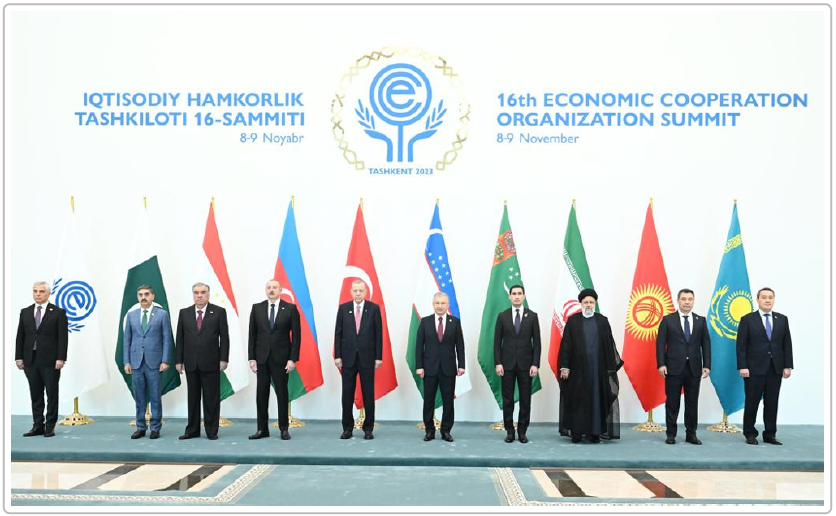
| Nov 8–9, 2023 | 16th ECO Summit in Tashkent, Uzbekistan (Figure 2). | Iran’s delegation led by President Raisi engages with all Central Asian heads of state. The Tashkent Communiqué stresses connectivity and post-pandemic economic recovery 54 55. Iran reiterates support for regional stability, including in neighboring Afghanistan. |
| Jan 2025 | Iran and Tajikistan sign a new Security Cooperation MoU 56 57. | Iran’s Interior Minister visits Dushanbe; agreement to jointly combat terrorism, narcotics, and organized crime, further solidifying the strategic partnership 57. |
| May 2025 | Prime Minister Abdulla Aripov of Uzbekistan leads a delegation to Tehran 58. | Multiple cooperation agreements inked on trade, energy, and transit. A joint economic forum connects Iranian and Uzbek businesses 59 60. Both sides underscore historical ties and shared interest in Afghan stability 35. |
| June 2025 | Foreign Minister Murat Nurtleu of Kazakhstan visits Iran 61. | High-level talks result in a diplomatic cooperation program and plans to expand Caspian port links 2 37. Trade up 50% in 2024 and both nations vow to keep that momentum, eyeing $3 billion trade in the future 2. |
Figure 2: Central Asian and Iranian leaders at the 16th Economic Cooperation Organization Summit in Tashkent, November 2023. Iran’s President Ebrahim Raisi (fourth from right) stands with (from left) ECO Secretary-General, Pakistan’s PM, Tajikistan’s President Emomali Rahmon, Azerbaijan’s President Ilham Aliyev, Uzbekistan’s President Shavkat Mirziyoyev (chair), Turkey’s President Recep Tayyip Erdoğan, Turkmenistan’s President Serdar Berdimuhamedow, Kyrgyzstan’s President Sadyr Japarov, and Kazakhstan’s Prime Minister Alikhan Smailov.
Regional organizations have been key arenas for Iran’s diplomacy. Gaining full membership in the Shanghai Cooperation Organization (led by China and Russia, and including all five Central Asian states) was a major milestone 52 . Iran’s entry, first approved in 2021 and finalized in 2023, signals its “Look East” alignment and offers a platform for security and economic collaboration with Central Asia outside Western frameworks 62 . Likewise, Iran is a founding member of the Economic Cooperation Organization (ECO) – which includes the five Central Asians, Turkey, Pakistan, and others – and regularly participates in ECO summits to promote intra-regional trade. For example, at the 2023 ECO Summit in Tashkent, Iran advocated “economic stability through connectivity,” supporting projects to integrate the region’s energy and transport networks 54 . Iran has also sought observer or partner status in the Russian-led EAEU (Eurasian union of Kazakhstan, Kyrgyzstan, etc.) to reduce tariffs – a free trade agreement between Iran and EAEU was approved by Iran’s parliament in 2023 29 .
These diplomatic moves reflect Iran’s effort to normalize and deepen ties that were sometimes strained in the past. During the 1990s and 2000s, Iran’s relations with certain Central Asian republics were uneasy – for instance, Tajikistan accused Iran of meddling in its civil war, and Turkmenistan frequently clashed with Iran over energy debts. By contrast, the 2020s have seen rapprochement. Iranian officials frequently highlight “civilizational” and “cultural commonalities” with Central Asia as a foundation for cooperation 63 64 . Such rhetoric has been matched by high-level exchanges, as seen in the flurry of visits in 2022 where “the visit of three Central Asian presidents to Iran in three weeks is not a coincidence” 65 . Analysts note that Russia’s war in Ukraine prompted Central Asian states to “open southern trade routes” and engage more with Iran as sanctions on Russia made northern routes uncertain 66 . Indeed, Tokayev’s June 2022 trip to Tehran came immediately after a tense meeting with Putin in St. Petersburg, symbolizing Kazakhstan’s intent to diversify partnerships 48 .
Another notable diplomatic dynamic is Iran’s relationship with Turkey and the emerging Organization of Turkic States (OTS). All the Turkic-speaking Central Asian countries (Kazakhstan, Kyrgyzstan, Turkmenistan, Uzbekistan) plus Azerbaijan formed the OTS under Turkey’s aegis – an entity in which Iran has no part. This could have posed a competitive bloc, but Iran has managed to maintain friendly bilateral ties with these states even as they deepen their Turkic cooperation. For example, Kazakhstan and others in OTS have balanced that by supporting Iran’s inclusion in forums like the SCO and ECO. Iran, for its part, emphasizes inclusive regionalism (its foreign minister in 2023 called for cooperation with both Persianate and Turkic nations) and has downplayed any rivalry with Turkey in Central Asia. Nevertheless, Tehran remains wary of pan-Turkic influence diminishing Iran’s own cultural ties, especially in Persian-speaking Tajikistan, which pointedly never joined the Turkic club.
In summary, Iran’s diplomatic outreach since 2020 has significantly improved its standing in Central Asia. By actively engaging in multilateral bodies and reciprocal state visits, Tehran has signaled that it sees the region as strategically vital. The result is a web of partnerships: Iran is now party to high-level dialogues on issues ranging from Afghan stability to Caspian Sea development with Central Asian governments. While these republics still carefully balance relations with great powers like China and Russia, they increasingly treat Iran as an important regional player – evident in their willingness to work with Tehran on transportation projects and to grant Iran observer/member status in their regional initiatives.
Military and Security Cooperation
Security cooperation between Iran and Central Asian states has historically been limited, but it has expanded in targeted areas such as counterterrorism, border security, and defense technology in recent years. Central Asia’s secular governments share Iran’s interest in combating Islamist extremist groups (e.g. ISIS Khorasan in Afghanistan) and narcotics trafficking from Afghanistan’s drug trade. Thus, new channels for intelligence-sharing and joint initiatives have emerged post-2020, albeit quietly.
One milestone was the opening of an Iranian drone factory in Tajikistan in May 2022 – Iran’s first such production facility abroad 67 . The plant in Dushanbe manufactures the Ababil-2 tactical UAV, a low-cost drone for reconnaissance and combat 68 . It was inaugurated by Iran’s military Chief of Staff Major General Mohammad Bagheri alongside Tajik defence officials 69 . This project signifies a high level of defense cooperation and trust between Tehran and Dushanbe, which just a few years prior had virtually no military ties. The drones give Tajikistan a new surveillance capability for border control, while providing Iran a foothold in the Central Asian defense market 67 . Notably, Iran reportedly asked Tajikistan not to transfer these drones during a flare-up of Tajikistan’s border dispute with Kyrgyzstan in 2022, reflecting Tehran’s desire to avoid fueling intra-Central Asian conflicts 70 . The drone initiative goes hand-in-hand with broader security agreements: in 2025, Iran and Tajikistan signed an MoU on security cooperation focusing on “combating organized terrorism, human trafficking, and smuggling” 57 . This MoU, signed by the countries’ interior ministers, aims to institutionalize intelligence cooperation and joint efforts against transnational crime. Tajikistan, which has faced threats from Islamist militants (including groups that fled Afghanistan), values Iran’s experience against terrorism, while Iran seeks Tajik partnership to secure the Afghan-Tajik-Iranian corridor against ISIS and drug cartels.
Other Central Asian states have also engaged Iran on security matters, though more cautiously. Within the Shanghai Cooperation Organization, Iran will participate in the SCO’s Regional Anti-Terrorist Structure (RATS) now as a full member, which facilitates counterterrorism intelligence sharing among China, Russia, India, Pakistan and Central Asia. Even before full membership, Iranian and Central Asian security services cooperated under SCO auspices in drills and info exchanges (for example, Iran observed SCO joint counter-terror exercises in past years). Now integration is expected to deepen – e.g. Iran can coordinate more closely with Kazakhstan’s and Uzbekistan’s security agencies on counter-extremism and narcotics interdiction under the SCO framework 71 .
Bilateral defense ties have seen incremental progress. Kazakhstan and Iran have a history of naval exchange in the Caspian Sea – both are littoral states and have partaken in Caspian security meetings. They maintain a dialogue on Caspian maritime security (search and rescue, anti-smuggling operations), and have agreed to prevent the sea from being used by outside militaries. Turkmenistan, which shares a long land and sea border with Iran, historically kept military ties minimal due to its neutrality policy. However, as of 2022, improved political ties led to discussions on border security collaboration. Turkmenistan faces similar issues of Afghan border control (drugs, refugee influx) and has quietly coordinated with Iran’s border guards on managing cross-border movements. For instance, joint border commission meetings resumed by 2023 to ensure the frontier remains secure and well-regulated (important for both, given the increased trade and transit).
Uzbekistan and Kyrgyzstan – both former Soviet states that traditionally bought arms from Russia – have shown some openness to engaging Iran on security. Uzbekistan under President Mirziyoyev has signed accords with Iran on extradition and legal assistance, which aids in cracking down on organized crime and extremist networks operating across borders. There were reports of Iran sharing intelligence with Uzbekistan regarding extremist recruiters targeting Central Asian migrant workers in Iran and the Middle East. Kyrgyzstan, for its part, cooperates with Iran mainly via multilateral venues (SCO, UN Office on Drugs and Crime). In 2022, the chiefs of drug control agencies of Iran and Kyrgyzstan met to coordinate anti-narcotics efforts, as Iran sits on a major heroin transit route that can extend to Central Asia. Kyrgyz officials have praised Iran’s role in regional anti-drug trafficking initiatives 50 .
A sensitive aspect is arms sales. With the 2020 expiry of the UN arms embargo on Iran, Tehran is theoretically free to export weapons. Central Asian governments, however, remain cautious about overt arms purchases from Iran due to geopolitical balancing. Instead, cooperation has taken the form of joint training and tech transfer. For example, Iranian military academies have offered limited training slots to officers from friendly states (Tajikistan has sent cadets to Iran’s military universities in the past). There are also reports that Kazakhstan has shown interest in Iran’s defense industries in areas like electronic warfare or drones, although no major deals are public. It is noteworthy that in 2023, Iran and Kazakhstan signed a memorandum to expand military cooperation – primarily symbolic, but indicating diplomatic intent to keep defense ties on the agenda.
Counterterrorism remains a shared priority. All Central Asian regimes are concerned about the resurgence of terrorist groups in Afghanistan after the Taliban’s return in 2021. Iran has hosted regional security dialogues on Afghanistan, inviting the Central Asian neighbors. They have common ground in urging the Taliban to form an inclusive government and deny safe haven to groups like ISIS-K and Al Qaeda 72 73 . In these forums (one was held in Tehran in 2022), Iran and Central Asian national security advisors discussed border security reinforcement and intelligence coordination around Afghan developments. Such efforts, though not heavily publicized, underscore that Iran’s security integration with Central Asia is growing in tandem with its economic and political integration.
In summary, while formal military alliances are absent, Iran and Central Asia have increased pragmatic security cooperation since 2020. From joint efforts against terrorism and drugs to ventures like the Tajik drone factory, Iran is leveraging its military expertise to build goodwill and capacity in the region. This remains an area with potential for expansion – constrained by Central Asia’s careful balancing (none want to alarm Russia or invite sanctions by deep defense ties with Iran) but driven by mutual security interests. The new Iran-Tajikistan security pact and Iran’s SCO membership in 2023 indicate that Tehran is steadily overcoming past distrust and positioning itself as a contributor to Central Asian stability 56 57 .
Cultural Engagement: Language, Education, and Soft Power
Iran’s cultural diplomacy in Central Asia capitalizes on historical and linguistic affinities, particularly with Persian-speaking communities. These efforts have gained momentum since 2020 as Iran seeks to strengthen people-to-people connections alongside official ties. The components of this cultural engagement include Persian language promotion, educational exchanges, media outreach, and religious-cultural linkages.
The most natural cultural partner for Iran is Tajikistan, where Persian (called Tajik) is the official language. Despite Tajikistan’s use of Cyrillic script, the spoken language is mutually intelligible with Farsi. Iran has long seen Tajikistan as part of the “Persianate” cultural sphere. After years of cold relations, cultural exchanges have flourished again in the 2020s. Iranian cultural centers in Dushanbe and Khujand have reopened and expanded Persian language courses. Iranian officials highlight that “Tajikistan is one of the countries within the Great Persian civilization sphere”, noting the Tajik public’s strong affinity for Iranian culture 64 . Indeed, Tehran’s bazaars are popular in Dushanbe, and demand for Iranian books, films, and products is notable 74. A vivid example is the Tajik enthusiasm for Iranian poetry and music: classical Persian poets like Hafez and Sa’adi are widely read in Tajikistan, and Iranian musicians have held concerts there (e.g. a classical music festival in 2023 featured Iranian performers). In return, Iran has celebrated Tajik literary icons like Rudaki; in 2021 Tehran hosted a symposium on Rudaki’s legacy, underlining shared heritage. Such cultural bonds are described by officials as “closely intertwined, creating significant potential for collaboration…rare among other nations” 75 . Over 50 cooperation agreements in cultural and scientific fields have been signed in recent years, including setting up an Iran-Tajikistan Friendship Society and technology center in Dushanbe 24 76 .
Beyond Tajikistan, Iran also engages the Turkic-majority states culturally, focusing on common Central Asian history and Islamic connections. In Uzbekistan, for instance, Iranian cultural diplomacy emphasizes the legacy of the Silk Road and scholars like Avicenna (Ibn Sina), a Persian polymath born in what is now Uzbekistan. During Uzbek PM Aripov’s 2025 visit to Iran, both sides lauded “centuries of mutual influence” and a “shared tapestry of art, literature, music, and philosophy” linking their peoples 77 . The historic cities of Samarkand and Bukhara, once centers of Persian culture, are highlighted as “monuments to a legacy of poetic and intellectual exchange” between Persians and Central Asians 77 . Iran has offered to assist Uzbekistan in restoring Persian architectural monuments and has increased scholarships for Uzbek students to study Persian language and literature in Tehran. Although Russian and English are more prevalent as second languages in Uzbekistan today, interest in Persian is growing slowly, particularly among historians and tourism professionals. In 2022, Tashkent University reinstated a Persian studies program with Iran’s support, aiming to train guides and translators for expected Iranian tourists as ties improve.
Kazakhstan and Kyrgyzstan also have seen cultural exchanges with Iran, albeit on a smaller scale. Both countries have Iranian cultural centers (Khane-ye Farhang) which hold Persian language classes, film screenings, and art exhibitions. A notable example is the “Iranian Film Week” that has become a regular event in Bishkek, Kyrgyzstan and Almaty, Kazakhstan 78 . These film festivals showcase Iranian cinema – which often garners international awards – to Central Asian audiences, facilitating cultural dialogue. In Kyrgyzstan, Iranian diplomats have actively translated Kyrgyz literature into Persian; for instance, classic Kyrgyz epics and modern novels were published in Tehran in Persian translation, as mentioned by the Iranian Ambassador 78 . This reciprocal approach (showcasing Iranian culture in Kyrgyzstan and vice versa) builds goodwill. The two countries also cooperate in academic exchanges: Bishkek’s universities have hosted Iranian professors for short-term lecturing on Persian literature and Islamic philosophy, while Kyrgyz scholars attend conferences in Mashhad and Qom on Persian cultural studies. Kazakhstan, being a more secular and ethnically diverse country, engages Iran in areas like archaeology and history – joint excavations of Silk Road sites have involved Iranian experts, given Iran’s experience in preserving ancient Persian sites.
Religious and media outreach are sensitive but present. All Central Asian nations (except secular Tajikistan) have Muslim-majority populations (primarily Sunni). Iran’s constitution encourages export of its Islamic Revolution ideals, but Tehran treads carefully in Central Asia to avoid conflict with the secular governments who are wary of any Islamist influence. Thus, Iran’s religious outreach is framed in cultural terms: Iran funds the restoration of Islamic heritage sites (such as historical mosques or shrines) rather than overt propagation of Shiism. For example, Iran contributed to renovating a 16th-century mosque in Kazakhstan’s Turkistan region, underscoring shared Islamic heritage rather than sectarian theology. Iranian clerical organizations also invite Central Asian clerics to attend educational courses in Iran – these are low-profile and focused on general Islamic scholarship. On the media front, Iran’s state broadcaster IRIB operates external services (like IRIB World Service) in various languages; a Tajik-language radio service has been broadcast by IRIB, which Tajik listeners could understand, though it faced restrictions during past strains. Since ties improved, Tajikistan has allowed Iranian media like Press TV and IRIB to increase content exchange. In 2022, Tajik state TV even aired an Iranian documentary series on the Persian New Year (Nowruz), reflecting a thaw. Iran and Kyrgyzstan similarly agreed to media cooperation – e.g. co-producing a documentary on the life of a Kyrgyz writer translated into Persian.
Educational exchanges form another pillar. Iran offers scholarships to Central Asian students for university programs in Iran, particularly in fields like Persian language, engineering, and medicine. Dozens of Tajik and Afghan students enroll in Iran’s universities each year, and now some Uzbeks and Kazakhs have started joining. Conversely, Iranian students and researchers have begun attending Central Asian universities for short-term programs, especially to study Russian or Turkic languages or to conduct Central Asian studies research. In 2023, for instance, a group of Iranian postgraduate students spent a semester at the Kazakh National University in Almaty under a new exchange MOU. Such people-to-people ties remain relatively limited in scale but symbolically important for long-term relationship building.
Finally, cultural cooperation also leverages shared traditions. Nowruz, the Persian New Year celebrated on the spring equinox, is a UNESCO-listed heritage that Iran and all Central Asian countries (plus Afghanistan) celebrate. Each year, Iran and its northern neighbors send cultural delegations to each other’s Nowruz festivals. In 2021 and 2022, despite pandemic restrictions, Iran hosted a Nowruz Festival in Shiraz with guests from Central Asia, and in 2023 Tajikistan reciprocated with Iranian artists headlining Dushanbe’s festivities. Such events reinforce a sense of common cultural space spanning the Persian and Turkic worlds.
In summary, Iran’s cultural engagement in Central Asia is characterized by “soft power” diplomacy emphasizing historical kinship and mutual enrichment rather than ideology. Tehran’s focus on language, arts, and education has helped improve its image and influence at the grassroots level, complementing the political and economic ties. The depth of these cultural bonds varies – strongest with Tajikistan, modest with others – but Iran clearly views cultural diplomacy as an integral part of its Central Asia initiative. As one Kyrgyz official noted, the high level of cultural cooperation, exemplified by film weeks and literary exchanges, builds a foundation of goodwill that can facilitate closer ties in other domains 78 .
Strategic Goals, Rivalries, and Constraints
Iran’s Central Asia strategy is driven by several strategic objectives: achieving economic gains, breaking international isolation, ensuring regional security, and competing for influence vis-à-vis other powers. At the same time, Iran faces significant constraints in realizing these ambitions, from sanctions-induced limitations to the geographic and geopolitical realities of Central Asia.
Strategic Goals:
1. Sanctions Evasion and Economic Relief: 1.With heavy U.S. sanctions squeezing its economy, Iran sees Central Asia as a sanctions bypass and new market. By trading in local currencies or via barter (for example, swapping oil for goods with Kazakhstan or Turkmen gas swaps), Iran can mitigate sanctions’ impact on dollar-based commerce 38 17 . Central Asia’s demand for Iranian products (food, petrochemicals, consumer goods) provides hard currency earnings for Iran’s non-oil sector 79 9 . Furthermore, using overland routes through Central Asia (and Russia) allows Iran to trade with partners like China and Russia while avoiding choke points like the Strait of Hormuz, which might be vulnerable in a crisis. The International North–South Corridor linking India-Iran-Russia (via Kazakhstan) is part of Iran’s plan to become a critical transit bridge, potentially bringing transit fees and strategic leverage 33 80 .
- Geopolitical Leverage and Breaking Isolation: Deepening ties in Central Asia helps Iran counter its isolation by the West. Gaining full SCO membership in 2023, for instance, was a diplomatic victory showing Iran’s acceptance into a major Eurasian bloc despite U.S. opposition 53 . Likewise, Iran’s active ECO role and budding EAEU ties project an image of a country engaged with its region. Tehran hopes that support from Central Asian states at international forums (e.g. the UN) can bolster Iran’s positions – for example, Central Asian countries have typically not supported Western resolutions against Iran’s nuclear program, often abstaining or advocating dialogue. Strategically, Iran also seeks balanced relations to avoid over-dependence on any single patron. As Iran aligns more with Russia and China, good ties with their Central Asian allies reinforce Tehran’s eastern pivot and reduce the effectiveness of any U.S.-led containment.
- Regional Security and Stability: Iran’s goals include preventing insecurity on its northeast frontiers. A stable Central Asia acts as a buffer against threats like terrorism and narcotics. Iran therefore aims to coordinate on containing Afghan instability. Tehran shares with Central Asian governments a desire to pressure the Taliban on inclusive governance and keeping extremist groups in check 72 . By working with countries like Tajikistan and Uzbekistan that border Afghanistan, Iran can improve surveillance of militant movements. Additionally, Iran wants to ensure that foreign (Western or Israeli) military presence in Central Asia remains limited – a concern it addresses diplomatically by common SCO stances opposing “interference under pretext of counterterrorism” 71 . Through security agreements (like the Iran-Tajik MoU) and intelligence sharing, Iran increases its strategic depth in the region, hoping to neutralize threats before they reach its borders.
- Cultural and Ideological Influence: While economic and security interests are paramount, Iran also harbors longer-term aspirations to be recognized as a cultural and ideological center in the Muslim world. In Central Asia, Iran’s cultural diplomacy (as detailed above) serves this goal by reviving Persian influence. The Iranian leadership likely views the spread of Persian language and the appreciation of Iranian culture in Central Asia as a strategic win that counters rival ideologies (whether pan-Turkism promoted by Turkey or Salafi Islamist trends). However, Tehran is careful not to overtly export its 1979 Revolution ideology, focusing instead on common heritage to win hearts and minds gradually.
Rival Powers: Iran’s initiatives unfold in a region where China, Russia, and Turkey have established footholds:
- China is now Central Asia’s largest economic partner, far outstripping Iran in trade and investment. Through the Belt and Road Initiative, China has built extensive infrastructure (pipelines, roads, railways) and holds significant political sway. Iran cannot compete in financial clout – Chinese trade with Central Asia is in the tens of billions versus Iran’s in the hundreds of millions 7 81 . However, Iran positions itself as complementary to China: for example, offering Chinese goods an additional route west via Iran, and partnering within the SCO where Beijing and Tehran find common cause opposing Western dominance 62 . Unlike in the Middle East where Iran vies with Saudi Arabia, in Central Asia Iran’s and China’s interests don’t fundamentally clash – both oppose extremist militancy and both benefit from continental trade growth. The risk for Iran is that Central Asian regimes prioritize ties with wealthy China, leaving Iran as a secondary player. Tehran’s strategy to mitigate this is to focus on niches (like cultural ties and certain industries) where it has an edge and to work with China (Iran joined China’s Asian Infrastructure Investment Bank and discussed aligning the INSTC with the BRI).
- Russia has historically seen Central Asia as its sphere of influence. Iran and Russia, though rivals in the past, have drawn closer, especially after 2022 when both faced Western sanctions. Moscow has tacitly welcomed Iran’s rising role in Central Asia to help Russia circumvent sanctions via north-south trade 80 . Joint Russia-Iran initiatives, such as integrating rail networks and harmonizing customs, have been reported as part of a budding “sanctions alliance” 82 . However, Russia likely prefers Iran to play a supportive rather than leading role. Central Asians also remain tied to Russia for security (CSTO, Russian military bases in Tajikistan and Kyrgyzstan) and labor migration, which Iran cannot replace. Iran must therefore carefully expand influence without alarming Moscow. So far, this has been successful – Russian experts actually “welcome [Iran’s] ever-increasing importance in Central Asian trade” as it strengthens regional connectivity beneficial to Russia too 81 . A potential point of friction could be arms sales if Iran were to supply weapons to Central Asia, intruding on Russia’s defense market, but Iran has largely avoided this. In essence, Iran has leveraged the Russia-China rivalry with the West to integrate into Eurasian structures (SCO, etc.) with Russian approval, thus turning a traditional rival into a quasi-partner in Central Asia.
- Turkey projects soft power in Central Asia through ethnic and linguistic kinship (the “Turkic world” concept) and via the Organization of Turkic States. Turkish influence—educational exchanges, business ties, cultural affinity—particularly resonates in Azerbaijan, Kazakhstan, Kyrgyzstan, and Uzbekistan. Iran views aspects of pan-Turkism with suspicion, especially any that might stoke separatist sentiments among Iran’s own sizable Azeri Turkish population. Nevertheless, Iran and Turkey have maintained a pragmatic relationship in Central Asia: they are economic competitors to a degree (both export similar goods to the region, and both vie for transit routes to Europe), but also share interest in stability and limiting Western presence. Central Asian states, for their part, balance multiple partners. For example, Kazakhstan’s President Tokayev in 2021 emphasized Turkic unity at a Turkic summit, and days later sent his foreign minister to Tehran to affirm Kazakhstan’s commitment to strong ties with Iran 36 2 . In practical terms, Turkey’s advantage is its cultural appeal and investment might (especially through private businesses and construction projects in Central Asia), whereas Iran’s advantage is geographic proximity and shared religion (to a point). Iran seeks to counter Turkey’s sway by emphasizing Persian culture’s deep roots in Central Asian history (as seen in Samarkand/Bukhara references) and by reminding Turkic governments that Iran is a neighbor that stood by them (for instance, Iran never recognized breakaway regions or engaged in patronizing behavior). Still, Iran likely perceives Turkey as a competitor for regional leadership. This is a subtle rivalry mostly playing out in the cultural domain and diplomatic symbolism (such as competing summitry) rather than open confrontation.
Constraints on Iran’s Role: Despite progress, Iran’s ambitions in Central Asia are curtailed by significant constraints:
- Sanctions and Economic Limitations: International sanctions on Iran’s banking and finance remain a primary obstacle to expanding trade and investment. Central Asian banks and companies are wary of U.S. secondary sanctions if they deal with Iran, which limits large-scale projects. For instance, while trade is growing, major Central Asian investment in Iran (or vice versa) has been scarce – no big joint ventures in oil/gas or mining have materialized because financing and technology often involve Western or allied firms. Iranian officials openly acknowledge that “banking obstacles remain a major challenge” and that “supportive policies” are needed to facilitate trade 38 4 . Moreover, Iran’s economy, under strain, cannot offer generous loans or grand infrastructure investments to Central Asia the way China or even multilateral development banks can. This means Iran often brings political will but not enough capital to the table – for example, plans to raise Iran-Kazakhstan trade to $3 billion or Iran-Turkmenistan to $5 billion are aspirational, contingent on private sectors and removal of financial barriers 83 17 .
- Geographical and Logistical Challenges: While Iran provides an outlet to open seas, it only directly borders two Central Asian states (Turkmenistan by land, Kazakhstan via the Caspian Sea). Trade with Uzbekistan, Tajikistan, and Kyrgyzstan must pass through third countries (Turkmenistan or Afghanistan) or across the Caspian. This raises transport costs and complexities. The lack of a direct Iran–Uzbekistan rail link, for instance, means goods travel a circuitous route or await the proposed Afghan corridor. Geography also imposes physical bottlenecks – the Caspian Sea connection is limited by shipping capacity and port infrastructure. In winter, rail and road through mountain passes (e.g. between Iran and Turkmenistan, or across Tajikistan’s terrain) can be slow. These factors make Central Asian trade with Iran competitive only for certain commodities unless transport is made more efficient. Both sides are investing in rail gauge swaps, new ports, and better roads, but these take time and money. Until then, Central Asian exporters might still prefer nearer markets (China, Russia) for bulk goods. Additionally, Iran’s terrain poses its own issues: to reach Iran’s major ports (Bandar Abbas, Chabahar), Central Asian goods must traverse Iran’s interior, which involves traversing mountains and deserts with limited rail lines. Iran is racing to complete projects like the Rasht-Astara rail (to close a gap on the INSTC), but delays hamper full utilization of the routes.
- Political Caution in Central Asia: Central Asian regimes generally practice a multi-vector foreign policy – they avoid aligning too closely with any one country. While they welcome Iran as a partner, they remain cautious not to provoke the U.S. or alienate other partners. For example, none of the Central Asian presidents openly defied U.S. sanctions by engaging in prohibited deals with Iran; their cooperation stays within the bounds of what won’t trigger major Western retaliation. Kazakhstan and Uzbekistan have each hosted high-level visits with Iranian leaders, but they equally maintain good relations with Washington and Tel Aviv (Kazakhstan even has a budding relationship with Israel, which Iran views with concern). So there is a ceiling to how far Central Asia will go with Iran – for instance, we have not seen offers for Iran to set up military facilities or a SCO base in Central Asia (something that would alarm the West and region alike). Iran’s sometimes hardline regional stance (e.g. its conflict with Israel or U.S. forces) is not fully endorsed by Central Asians, who prefer neutrality. This political pragmatism can slow or limit strategic agreements. A telling example: when Iran sought full membership in the SCO, it needed unanimous approval; reportedly, Tajikistan initially hesitated (due to past grievances) until rapprochement was achieved in 2021 45 . Similarly, Turkmenistan, despite cultural ties, has not joined Iran’s initiated alliances (Ashgabat stays neutral and even kept distance from Iran’s conflicts with Azerbaijan or the Taliban). Thus, Iran must continually reassure Central Asian states that partnership with Tehran won’t drag them into unwanted entanglements.
- Internal and External Stability: Iran’s own domestic stability and its relations with great powers also affect its Central Asia policy. Domestic unrest or economic crises in Iran (like the late 2022 protests or currency volatility) can distract and weaken Tehran’s outreach. Externally, if Iran’s tensions with the West or Israel escalate (for instance, a confrontation over the nuclear issue), Central Asian countries may distance themselves to avoid being caught in the middle. Already, there are subtle signs: some Central Asian airlines avoided Iranian airspace at times of Gulf tensions, and none have publicly supported Iran’s positions on contentious issues such as its nuclear enrichment beyond general calls for diplomacy. Moreover, Israel has tried to cultivate ties in Central Asia (opening an embassy in Turkmenistan in 2023, and increasing security cooperation with Kazakhstan). Iran perceives such moves as attempts to encircle it; if Israel were to establish any intelligence presence in these countries, Iran’s relations with the host nation could strain. Tehran will have to use diplomatic channels to ensure Central Asian partners do not aid any Israeli or Western security initiatives against Iran (a concern given reports of Israeli-Azeri intelligence on Iran, which Iran would not want replicated in, say, Kazakhstan) 67 .
In conclusion, Iran’s “Central Asia Initiative” since 2020 has achieved considerable progress in boosting Iran’s economic ties, political integration, security collaboration, and cultural presence in its northeastern neighborhood. Trade has grown (Figure 1), high-level visits and summits (Table 1) have normalized previously frosty relationships, and new agreements in security and cultural fields underscore a broadening partnership. Iran’s strategic goals – securing economic lifelines, expanding geopolitical influence, and contributing to regional stability – are being pursued through pragmatic, multi-faceted engagement. Central Asian states, motivated by their own need for diversified partnerships and transit routes, have largely reciprocated, bringing Iran in from the cold of the 1990s into the regional fold of the 2020s.
Yet, Iran’s ambitions remain tempered by the reality of great power competition and enduring constraints. China’s economic dominance, Russia’s historical influence, and Turkey’s cultural ties ensure that Iran is one of several major actors in Central Asia – and not the most powerful one. Furthermore, sanctions and geography place practical limits on how quickly Iran can scale up its role. Iran must navigate these challenges shrewdly: leveraging cooperation with Russia and China where interests align, quietly countering rival influences through soft power rather than hard power, and relentlessly working to remove or work around the barriers imposed by sanctions. If it can do so, Iran stands to solidify a long-term strategic presence in Central Asia – reconnecting a region that was once closely linked to Persian civilization and now, in the 21st century, finding renewed linkages with the Islamic Republic of Iran.
Sources:
- Tehran Times, Iran’s agriculture minister left Tehran for Astana... (Nov 2024) –Non-oil export growth to Kazakhstan 3 4 .
- Astana Times, Kazakh FM Visits Iran... (June 2025) – 2024 trade +12.3% to $340m; Q1 2025 surge 2 .
- Trend News Agency, Kazakhstan… trade turnover with Iran… (May 2024) – Yearly trade figures 2019– 2023 1 .
- Uzasiaexport/Trend, Uzbekistan… trade turnover with Iran… (Dec 2024) – Jan–Nov 2024 trade $448m (slight drop from 2023) 7 .
- MEPEI (via Caspian News), Iran–Uzbekistan relations… (May 2025) – Trade ~$435m by end 2022 6 .
- Abrisham Road, Export to Uzbekistan... (Mar 2025) – 2024 trade $405m; Iran exports $268m 9 .
- Iran Daily, Iran-Tajikistan trade targeted $1b... (Mar 2025) – Trade: $140m (2021), $240m (2022), ~$350m (2024) 22 .
- RFE/RL (Bruce Pannier), Central Asia in Focus (June 21, 2022) – “three Central Asian presidents in three weeks” visits to Iran, new train route 48 45.
- Jamestown Foundation (Paul Goble), Iran Increasing Influence… (Sep 2024) – Iran-Turkmen routes aid Russia sanctions evasion; Iran’s trade importance welcomed 80 81 .
- J. Post, Iran & Tajikistan sign agreement... (Apr 2025) – Security MoU (terrorism, trafficking); drone factory (May 2022) 56 57.
- Kazinform (via Kabar), Iran-Kyrgyzstan trade… (May 2025) – 2024 trade $58.5m, cultural cooperation (film weeks, literature) 26 78 .
- Anadolu Agency, Iran becomes full member of SCO (Jul 2023) – SCO membership confirmed 52 .
- Tehran Times, Tehran prepares to host Uzbek PM... (May 2025) – Raisi-Mirziyoyev 2022 $1bn trade goal; cultural ties Samarkand/Bukhara 10 77.
- Tehran Times, Iran exports $95.3m to Kyrgyzstan in 10 months (Mar 2025) – Iranian year 1403: $95m exports 28 29 .
- Astana Times, Kazakh FM in Iran... (June 2025) – Emphasis on Caspian transit, INSTC; signed diplomatic MoUs 36 37 .
- Tehran Times, Iran-Turkmenistan roadmap $3b trade (May 2025) – Planned free zones, rail, gas projects; trade nearly $600m in 2024 15 13 .
- Eghtesad Online, Iran to raise trade with Turkmenistan to $5b (June 2025) – Ambassador: current $500m trade, $100m exports; plans for banks in Ashgabat 17 18 .
- Tehran Times, Iran-Tajikistan Parl. Friendship (Mar 2025) – 50+ agreements signed; deep cultural ties, rare potential 24 75 .
- ECO Summit Tashkent 2023 (eco.int) – Photo of leaders at 16th ECO Summit (Nov 2023) 55.
- Additional data from Trading Economics / UN COMTRADE via Trend.az for trade statistics 49 84 .
1, 49 Kazakhstan sees decline in trade with Iran over past five years - Trend.Az
https://en.trend.az/casia/kazakhstan/3897265.html
2, 36, 37, 61 Kazakh FM Visits Iran to Bolster Bilateral Ties - The Astana Times
https://astanatimes.com/2025/06/kazakh-fm-visits-iran-to-bolster-bilateral-ties/
3, 4, 5, 38, 40, 41, 63, 79, 83 Iran’s agriculture minister left Tehran for Astana leading a trade-agriculture delegation - Tehran Times
https://www.tehrantimes.com/news/514144/Iran-s-agriculture-minister-left-Tehran-for-Astana-leading-a
6 Iran – Uzbekistan Relations: Opportunities, Challenges, and Prospects
https://mepei.com/iran-uzbekistan-relations-opportunities-challenges-and-prospects/
7, 84 Uzbekistan reveals trade turnover volume with Iran in 11M2024 - Uzasiaexport platform - B2B e-commerce platform
https://uzasiaexport.com/exhibitions/uzbekistan-reveals-trade-turnover-volume-with-iran-in-11m2024.htm
8, 9 Export to Uzbekistan: Golden Opportunities for Products & Trade Growth
https://abrishamroad.com/blog/export-to-uzbekistan-golden-opportunities-for-iranian-products-trade-growth
10, 12, 35, 58, 59, 60, 77 Tehran prepares to host Uzbek PM for talks on expanding economic, political ties - Tehran Times
https://www.tehrantimes.com/news/512874/Tehran-prepares-to-host-Uzbek-PM-for-talks-on-expanding-economic
11, 28, 29, 50, 51 Iran exports commodities worth $95.3m to Kyrgyzstan in 10 months - Tehran Times
https://www.tehrantimes.com/news/511086/Iran-exports-commodities-worth-95-3m-to-Kyrgyzstan-in-10-months
13, 14, 15, 16, 19, 20, 21, 39 Iran, Turkmenistan sign roadmap targeting $3b in trade - Tehran Times
https://www.tehrantimes.com/news/513337/Iran-Turkmenistan-sign-roadmap-targeting-3b-in-trade
17, 18 Iran plans to raise annual trade with Turkmenistan to $5bln
https://en.eghtesadonline.com/en/news/2001378/iran-plans-to-raise-annual-trade-with-turkmenistan-to-$5bln
22, 23, 24, 25, 46, 64, 74, 75 Iran-Tajikistan annual trade targeted at $1b: Lawmaker
https://newspaper.irandaily.ir/7793/3/14438
26, 78 Iran - Kyrgyzstan trade hit USD 58.5 mln in 2024
https://qazinform.com/news/iran-kyrgyzstan-trade-hit-usd-585-mln-in-2024-c437cb
27 Trade turnover between Kyrgyzstan and Iran decreases by 11% in 2024 - AKIpress News Agency
https://akipress.com/news:819402:Trade_turnover_between_Kyrgyzstan_and_Iran_decreases_by_11__in_2024/
30, 31, 76 Iran, Kyrgyzstan approved MoU for port development
https://iranpress.com/content/284194/iran-kyrgyzstan-approved-mou-for-port-development
32, 33, 34, 45, 47, 48, 65, 66 Central Asia in Focus: June 21, 2022
https://about.rferl.org/article/central-asia-in-focus-june-21-2022/
42, 43, 80, 81, 82 Iran Increasing Its Influence in Central Asia With Expanded Trade across Turkmenistan - Jamestown
https://jamestown.org/program/iran-increasing-its-influence-in-central-asia-with-expanded-trade-across-turkmenistan/
44, 52, 53, 71, 72, 73 Iran becomes full member of Shanghai Cooperation Organization
https://www.aa.com.tr/en/asia-pacific/iran-becomes-full-member-of-shanghai-cooperation-organization/2936909
54 16th Economic Cooperation Organization Summit
https://gov.uz/en/news/view/3416
55 16th ECO Summit - November 9, 2023 -Tashkent - Economic Cooperation Organization
https://eco.int/16th-eco-summit-november-9-2023-tashkent/
56, 57, 62, 67, 70 Iran and Tajikistan sign deal as Tehran looks to central Asia | The Jerusalem Post
https://www.jpost.com/international/article-851182
68, 69 Iran Opens Ababil-2 Drone Factory in Tajikistan: Reasons and ...
https://jamestown.org/program/iran-opens-ababil-2-drone-factory-in-tajikistan-reasons-and-implications/