Current State of Iran–United States Relations (2023–2025)
Introduction
Relations between the Islamic Republic of Iran and the United States remain adversarial and complex in the period from 2023 to mid-2025. Despite the absence of formal diplomatic ties since 1980, both countries have engaged indirectly on critical issues such as nuclear activities, regional security, and detained nationals. Recent years have seen shifts in policy and strategy on both sides: the U.S. under the Biden administration initially pursued a return to the 2015 Iran nuclear deal but later pivoted to containment and pressure, while Iran under President Ebrahim Raisi deepened alliances with Russia and China and sought sanctions relief without conceding on core security interests 1 2 . This article provides an academic overview of key developments in Iran-U.S. relations since 2023, covering political relations (official statements, sanctions, policy shifts), economic ties (sanctions impact, trade and energy flows), military tensions (maritime incidents and regional deployments), nuclear negotiations (the status of the Joint Comprehensive Plan of Action, or JCPOA), and diplomatic engagement channels (prisoner swaps, backchannels, and third-party mediators). Emphasis is placed on events and trends in 2023 through mid-2025, with visual data and timelines to illustrate trade volumes, military incidents, and diplomatic contacts. The goal is to elucidate the current state of this fraught bilateral relationship, drawing on official statements, think-tank analyses, reputable news reporting, and other authoritative sources.
Political Relations and Policy Shifts
Official Rhetoric and Policy Stance: The political atmosphere between Washington and Tehran in 2023– 2025 has been marked by public recriminations and cautious indirect dialogue. U.S. officials have consistently reiterated that Iran must not be allowed to acquire nuclear weapons and have condemned Iran’s support for militant proxies and human rights abuses 3 4 . President Joe Biden and his administration voiced support for Iranian protesters during the late-2022 unrest over women’s rights, with new sanctions on Iranian officials involved in the crackdown and measures to improve Iranians’ internet access 5 6 . In turn, Iran’s leadership has accused the U.S. of fomenting domestic dissent and insisted that Washington must lift sanctions and “change course” to rebuild trust 7 8 . At the UN General Assembly in September 2023, Iran’s President Ebrahim Raisi lambasted U.S. sanctions as ineffective and illegitimate, while also warning that Iran would retaliate for the U.S. assassination of IRGC General Qassem Soleimani in 2020 8 .
Sanctions Policy: Sanctions remain the centerpiece of U.S. political pressure on Iran. Since 2018, when the U.S. withdrew from the JCPOA, wide-ranging sanctions have targeted Iran’s energy, financial, and industrial sectors 9 10 . Under President Biden, most Trump-era sanctions stayed in place; however, the administration coordinated more closely with European allies on new designations and also imposed human rights sanctions related to protest crackdowns and Iran’s drone supplies to Russia 11 12 . Notably, October 2023 saw a policy juncture: United Nations restrictions on Iran’s ballistic missile activity expired per the JCPOA’s timetable, but the United States, United Kingdom, France, Germany and dozens of other countries immediately pledged to maintain or introduce their own sanctions to prevent Iran’s missile proliferation 13 14 . In a joint statement, the E3 (UK, France, Germany) cited Iran’s “consistent and severe non-compliance” with nuclear commitments as justification for continuing sanctions due to expire under UN Resolution 2231 15 . The U.S. likewise affirmed it would snap back unilateral measures on Iran’s missile program the moment UN restrictions lapsed 16 17 . This effectively extended the arms and missile embargoes on Iran beyond October 2023 in practice, underscoring a transatlantic policy shift toward tighter coordination on Iran sanctions 17 13 .
Another emerging trend in U.S. sanctions policy has been a focus on enforcement and evasion networks. Throughout 2023 and early 2024, the U.S. Treasury’s Office of Foreign Assets Control (OFAC) announced multiple rounds of designations on companies and individuals facilitating Iranian oil exports (often through a “shadow fleet” of illicit tankers) and those involved in Iran’s drone and missile programs 18 17 . A February 2025 Reuters report (set against the backdrop of a hypothetical second Trump administration) highlighted that Iran’s oil trade had been remarkably resilient – earning Tehran an estimated $53–54 billion in 2022–2023 despite sanctions – due largely to sales to China via sanctions-evasion channels 11 19 . U.S. officials across administrations warned that anyone dealing with Iranian oil faces “significant sanctions risk” 20 . Meanwhile, Iran has forged financial workarounds (such as trading in Chinese yuan through intermediaries) to blunt U.S. sanctions 19 .
Policy Shifts and Signals: By late 2023, Washington’s approach to Iran had shifted from hopes of JCPOA revival to a strategy of tension management and containment. This was publicly acknowledged in December 2023, when senior U.S. diplomat Kurt Campbell told Congress that restoring the 2015 nuclear deal was “just not on the table” under current conditions 21 22 . The Biden administration instead pursued informal understandings to cap Iran’s nuclear progress and de-escalate conflicts, without offering major sanctions relief that would trigger congressional review 23 24 . For example, U.S. officials signaled willingness to freeze some Iranian assets abroad or not impose new oil sanctions if Iran halted 60% uranium enrichment and freed American detainees 25 26 . Such arrangements would be framed as an unwritten “mutual understanding” rather than a formal agreement requiring legislative approval 23 27 . Tehran, for its part, sent mixed signals – slowing certain nuclear activities (as discussed later) and engaging in prisoner swaps, yet also restricting UN inspections and deepening ties with sanctioned states like Russia 28 29 . By mid-2025, Iran’s orientation remained defiantly anti-Western in rhetoric, but pragmatically Iran has also sought to avoid direct military confrontation with the U.S. while capitalizing on opportunities (such as higher oil prices and new partners) to withstand pressure 12 30 .
One striking political communication occurred in late October 2023 amid a regional war: President Biden sent a direct message to Iran’s Supreme Leader Ayatollah Khamenei – through backchannels – warning Tehran against attacking U.S. personnel in the Middle East 31 32 . As Iran’s proxy militias stepped up strikes on U.S. bases after the Hamas–Israel conflict erupted, Biden privately cautioned that the U.S. would respond militarily if such attacks continued 33 . The White House rarely acknowledges such leader-to-leader messages, indicating the gravity of the situation. This episode exemplified the mix of deterrence and diplomacy in Biden’s Iran policy: using secret channels to avoid miscalculation, even as public rhetoric and sanctions remained tough. In summary, political relations in 2023–2025 have been characterized by mutual distrust, periodic escalations, and careful calibration. U.S. policy shifted from attempting a JCPOA revival to enforcing redlines (nuclear and regional security) through sanctions and limited diplomacy. Iran’s policy, shaped by hardliners, emphasized resistance to U.S. pressure while leveraging any openings (such as prisoner deals or regional realignments) to advance its interests. Neither side has fundamentally changed its view of the other as a strategic adversary, but both have engaged in tactical diplomacy to prevent uncontrolled escalation.
Economic Ties Under Sanctions
Economic relations between Iran and the United States are extremely limited due to decades of U.S. sanctions. There are no normal trade or investment flows; instead, economic ties revolve around U.S. sanctions enforcement and Iran’s efforts to evade these restrictions. Official bilateral trade is almost nil, consisting mainly of humanitarian exports (like medicine) from the U.S. and virtually no imports.
34 35 The chart below illustrates the annual trade volume in goods between the U.S. and Iran in recent years (in millions of USD). It highlights the dramatic impact of sanctions on commerce: after the U.S. exited the JCPOA in 2018 and reimposed sanctions, trade collapsed to a mere fraction of previous levels. U.S. exports to Iran – mostly medical supplies, grain, and other permitted humanitarian goods – fell from over $136 million in 2017 to just $36–45 million per year during 2020–2022 36 37 . Imports from Iran (which had included Persian rugs, pistachios, and other items briefly allowed under the JCPOA) virtually disappeared after 2018 38 39 . By 2019–2021, U.S. imports from Iran were under $5 million annually, indicating an almost total embargo 40 36 .
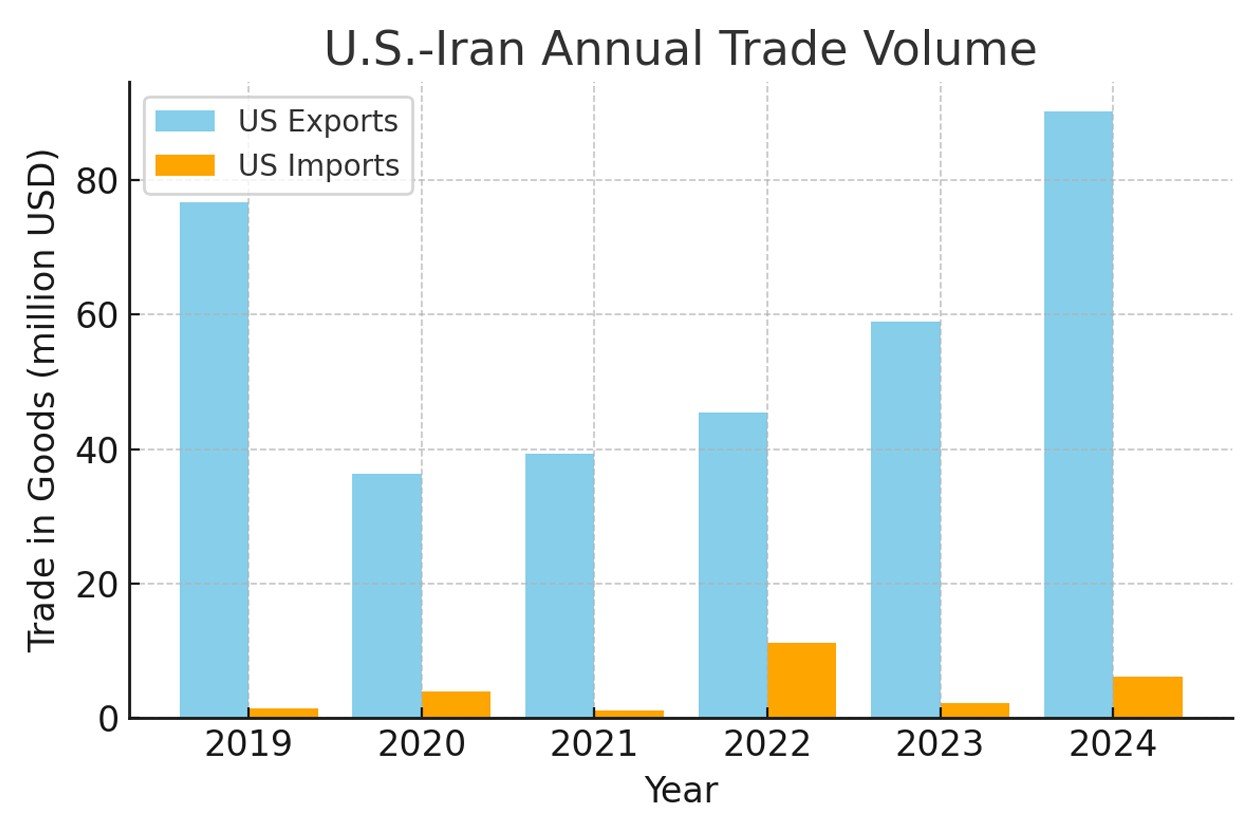
Figure: U.S.-Iran Annual Trade Volume, 2019–2024. U.S. Census Bureau data show the collapse of bilateral trade after 2018. Even humanitarian-related exports from the U.S. to Iran remain low (tens of millions USD), while U.S. imports from Iran are nearly zero 39 40 . A slight uptick in 2023–2024 reflects licensed medical exports and increased enforcement of reporting, but overall trade is negligible.
Despite sanctions, Iran’s economy stays afloat primarily through oil and petrochemical exports to countries like China, and through regional trade that circumvents U.S. restrictions. American sanctions have not eliminated Iran’s oil revenues – in fact, U.S. Energy Information Administration estimates cited by Reuters indicate Iran earned about $54 billion from oil exports in 2022 and $53 billion in 2023 11 . This was aided by high global oil prices and lax enforcement in some periods. By late 2023, Iran’s oil output had climbed to its highest level since 2018 17 . China, which does not recognize U.S. secondary sanctions, has been the main buyer of Iranian crude, often using networks of front companies and tankers operating in gray zones to avoid detection 19 . To counter this, the U.S. Treasury and State Department periodically sanction shipping firms, trading companies, and even Iranian officials involved in the oil sector. For example, in 2023 the U.S. sanctioned the head of Iran’s National Iranian Oil Company and an array of tanker operators in the UAE, Hong Kong, India, and China that were part of Iran’s “shadow fleet” moving sanctioned oil 41 42 . These enforcement actions aim to “target all aspects of Iran’s oil supply chain,” as a U.S. Treasury official put it 20, and to choke off funds that Iran could use for its nuclear and missile programs.
It is important to note that direct U.S.-Iran trade remains a tiny fraction of Iran’s overall commerce. Iran’s reported total exports exceed $100 billion annually (mostly energy and metals) 43 44 , whereas trade with the U.S. is under $0.1 billion. According to Iranian and U.S. data, bilateral trade even saw a modest increase in 2023–24: Iran’s imports of U.S. medical and agricultural goods rose slightly, and the U.S. even imported a few million dollars’ worth of Iranian goods (possibly carpets or food items) after some sanctions waivers 34 45. The Iranian press highlighted that U.S.-Iran trade volume doubled in the first quarter of 2024 compared to the year prior – but this “doubling” was from a mere $13.6 million to $27.7 million 34 46 . In other words, the absolute levels remain minuscule. For the full year 2023, total goods trade was about $61 million, up from ~$57 million in 2022 46 . The U.S. export surplus persisted, as Iran buys permitted goods like pharmaceuticals, while the U.S. imports almost nothing from Iran 45 47 . Iran ranks near the very bottom of U.S. trading partners (often around 150th place by export destination) 48 .
Sanctions on Iran’s energy exports have been a particularly contentious aspect of U.S. policy. These sanctions prevent U.S. entities and third parties (through secondary sanctions) from purchasing Iranian oil or gas. Yet Iran has found ways to sell oil to willing buyers. In addition to China, countries like Syria and Venezuela (also under sanctions) have bartered with Iran for oil. The U.S. Congress and administration have debated how vigorously to enforce oil sanctions, balancing pressure on Iran with the risk of spiking global oil prices. In late 2022 and 2023, some analysts argued the Biden administration was tacitly allowing higher Iranian oil exports to avoid price increases after Russia’s Ukraine invasion tightened oil supply 49 50 . However, facing criticism, the U.S. tightened enforcement again by 2023’s end – for instance, seizing Iranian oil cargoes violating sanctions. One high-profile case was the U.S. seizure of the Suez Rajan, a tanker carrying Iranian crude, which led Iran to retaliate by briefly detaining other tankers (discussed in the next section) 51 52 .
In summary, the economic “relationship” is defined by sanctions and circumvention. The U.S. uses economic leverage to try to alter Iran’s policies (nuclear, regional, human rights), while Iran seeks to withstand and work around these measures. Trade volume data and energy export figures show that Iran’s economy has adjusted to a sanctions environment, albeit at significant cost (inflation, reduced investment, etc.). Without a diplomatic breakthrough like JCPOA restoration (which would bring sanctions relief), this pattern of constrained economic ties is likely to continue. Iran will depend on non-Western partners and illicit networks for trade, and the U.S. will continue leveraging its financial power to isolate Iran – a dynamic that shapes the broader bilateral relationship.
Military Tensions and Security Incidents
Military and security tensions between Iran and the U.S. have been high in the 2023–2025 period, characterized by clashes at sea, proxy conflicts on land, and mutual military posturing. Both nations have avoided direct war but engaged in a shadow conflict across the Middle East. Key flashpoints include the Persian Gulf and Strait of Hormuz (vital waterways for oil shipping), and Iraq/Syria, where U.S. forces face Iran-backed militias. Below is a timeline graphic highlighting major military/diplomatic events since 2023, followed by detailed discussion of these incidents and their implications:
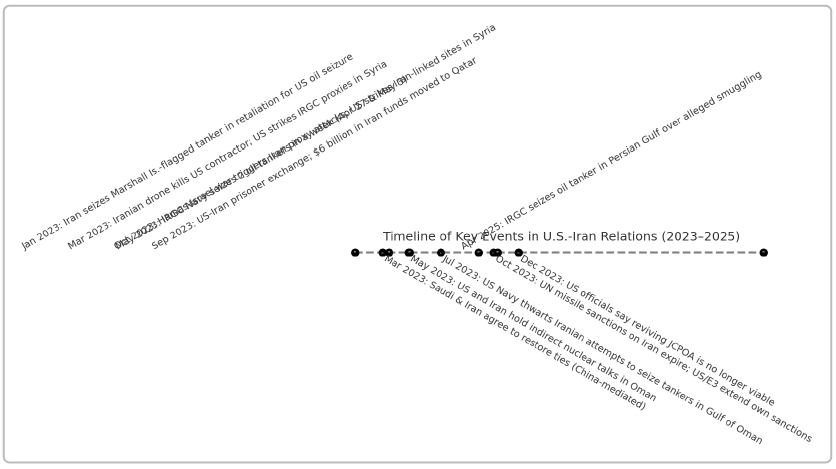
Figure: Timeline of Key Events in U.S.-Iran Relations (2023–2025). This timeline highlights notable incidents and diplomatic engagements. These include tanker seizures (Jan, Apr/May 2023, Apr 2025), proxy clashes in Syria (Mar 2023, Oct 2023), a China-brokered Saudi-Iran détente (Mar 2023), U.S.-Iran backchannel talks in Oman (May 2023), a prisoner swap (Sep 2023), and escalations around the Israel-Hamas war (Oct 2023). The timeline underscores the recurring pattern of maritime incidents and proxy confrontations, even as diplomatic efforts intermittently occur.
Persian Gulf and Strait of Hormuz Incidents
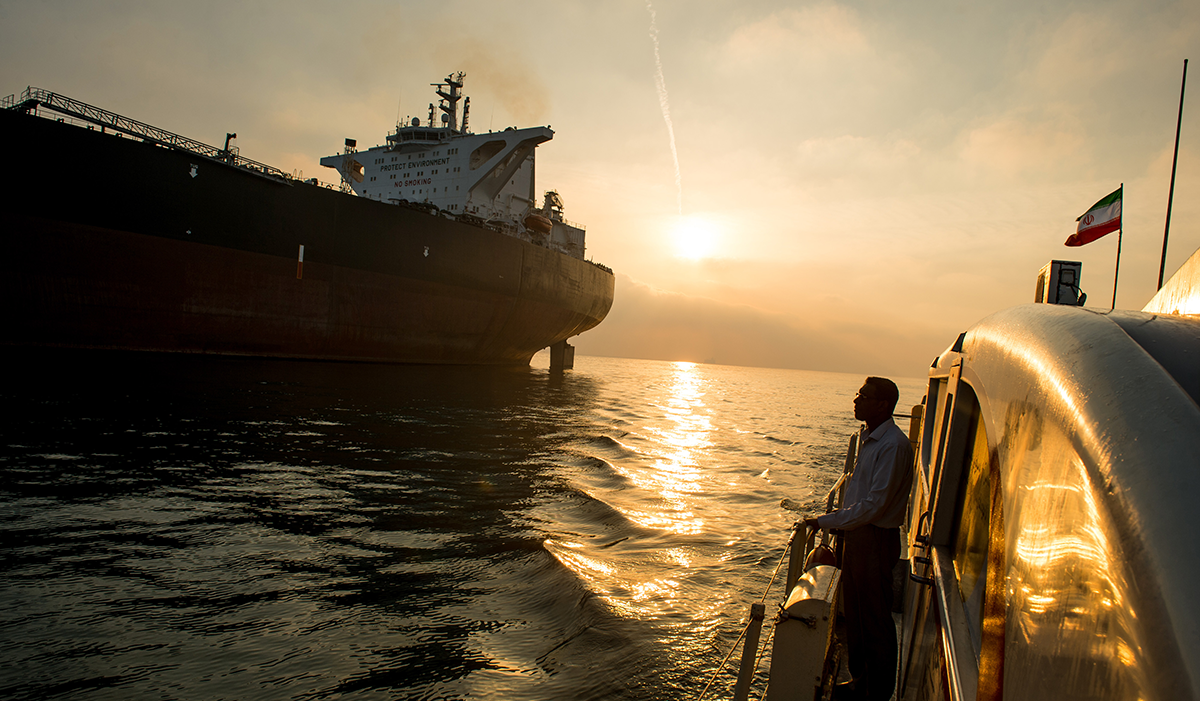
The Persian Gulf and adjacent Gulf of Oman saw a string of incidents involving Iranian forces and commercial vessels, raising the risk of U.S.-Iran naval confrontation. Iran’s Islamic Revolutionary Guard Corps (IRGC) Navy and regular Navy have periodically seized or harassed foreign oil tankers, often in retaliation for U.S. actions. In April 2023, Iran detained the Advantage Sweet, a Marshall Islands-flagged oil tanker carrying crude for a U.S. company, citing a legal dispute (a supposed collision with an Iranian ship) 51. A few days later in early May 2023, the IRGC seized a second tanker (Niovi) in the Strait of Hormuz. These back-to-back seizures came after the U.S. had forced a tanker carrying Iranian oil (the Suez Rajan) to discharge its cargo as part of sanctions enforcement 53 . Iran’s moves were widely seen as retaliatory – using commercial shipping as leverage against U.S. confiscation of Iranian oil assets 52 .
The U.S. Navy responded by increasing its presence in regional waters. On July 5, 2023, U.S. Naval Forces Central Command announced it had foiled Iranian attempts to seize two more tankers in the Gulf of Oman 54 55 . In that incident, the guided-missile destroyer USS McFaul raced to assist the Marshall Islands-flagged TRF Moss and the Bahamian-flagged Richmond Voyager, which had been pursued by Iranian naval vessels. Iranian forces even opened fire on one tanker with small arms before fleeing when the U.S. warship arrived 56 57 . According to U.S. officials, Iran’s navy had attempted to board or seize nearly 20 internationally-flagged ships in the broader Hormuz area since 2021 58 59 . Iran often justifies these actions as enforcing laws (e.g. against smuggling or for environmental fines), but the U.S. alleges they are blatant acts of aggression and extortion at a global chokepoint 60 61 .
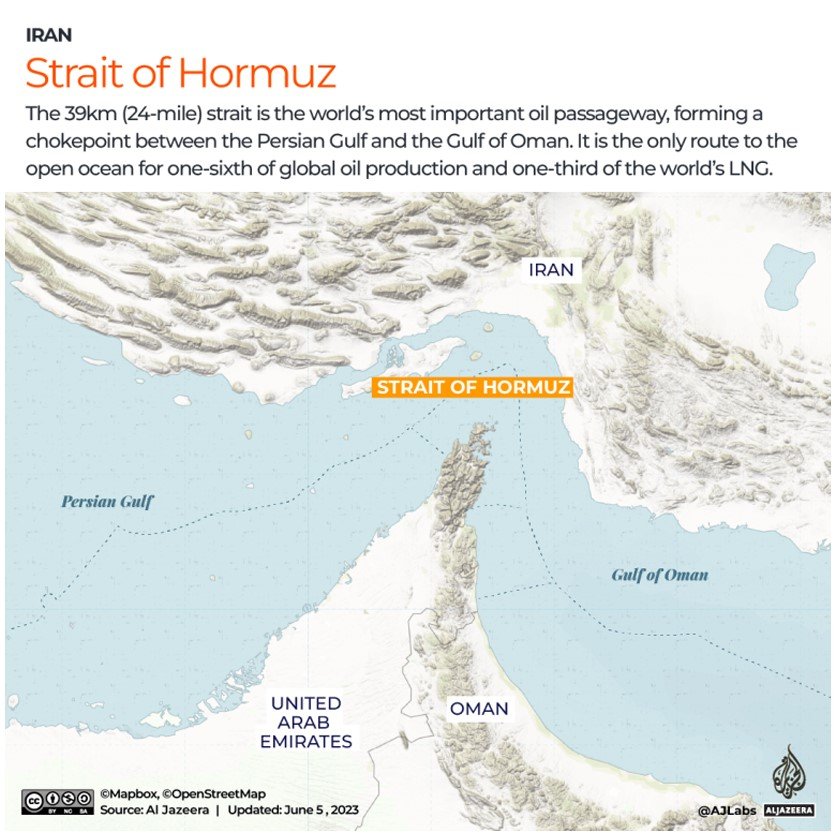
Figure: Map of the Strait of Hormuz and Persian Gulf region. The Strait of Hormuz, only 39 km wide at its narrowest, is a strategic chokepoint through which about one-sixth of global oil supply transits【40†look】. Iran and Oman border this vital passage. Iranian forces have used their geographic advantage to harass shipping here, leading the U.S. to bolster naval patrols in these waters.
The U.S. labeled Iran’s behavior in the strait as a threat to freedom of navigation and international commerce. In response, the Pentagon in mid-2023 deployed additional military assets to the region. This included sending F-35 stealth fighters and F-16 jets, as well as the destroyer USS Thomas Hudner, to augment patrols around the Strait of Hormuz 62 63 . The Defense Department explained this was to monitor the critical waterway after Iran’s repeated seizures of vessels 62 . By July 2023, U.S. officials even discussed embarking armed Marines and sailors on commercial tankers as an extra protective measure 64 . The overarching goal was to deter Iran by making it clear the U.S. would physically intervene to stop seizures – as it did on July 5 – and to reassure global shipping companies and Gulf allies of safe passage. About one-fifth of the world’s oil passes through Hormuz 65 , so these incidents have international implications for energy markets and security.
Iran’s motivations for these maritime provocations include retaliating against U.S. enforcement actions, demonstrating leverage (they can threaten oil flows), and rallying nationalist support domestically. However, Iran also faces the risk of triggering a direct conflict with the far superior U.S. Navy. Thus, these incidents have typically been cat-and-mouse games: Iran seizes a ship or two and then releases them after a few weeks (often once a behind-the-scenes deal or message is conveyed), while the U.S. increases military presence but avoids firing the first shot. This pattern continued into 2025. In April 2025, the IRGC Navy seized another tanker in the Persian Gulf, alleging it was smuggling fuel 66 . Iranian media noted this followed an IRGC operation a month prior in which two other fuel-smuggling vessels were detained 67 . Such seizures under the pretext of stopping smuggling are common – Iran’s waters are indeed a route for fuel smuggling, but Iran also uses these operations to assert authority in the Gulf.
In sum, the Persian Gulf has remained a potential flashpoint. The U.S. and Iran have come dangerously close to direct naval clashes. Each seizure or attempted seizure prompts a U.S. military reaction (deployments, escorts, or occasionally lethal force, as in 2018’s Operation Praying Mantis or the downing of an Iranian drone in 2019). Fortunately, recent incidents have not resulted in casualties, and communication (often via third parties like Oman) has helped defuse crises. Yet the possibility of miscalculation is ever-present – a firefight at sea or an accident could escalate quickly given the heavy U.S. and Iranian military presence in the area.
Clashes with Iran-Backed Militias in Iraq and Syria
Another arena of U.S.-Iran tension has been on the ground in Iraq and Syria, where roughly 2,500 U.S. troops (in Iraq) and 900 troops (in Syria) remain deployed to combat ISIS remnants and support local partners 68 69 . Iran wields significant influence in both countries through Shiite militia groups that it funds, arms, and directs. These militias (such as Kata’ib Hezbollah in Iraq and various units within Iraq’s Popular Mobilization Forces, as well as groups like Liwa Fatemiyoun and others in Syria) have frequently targeted U.S. bases with rockets and drones – a form of proxy warfare that allows Iran deniability. U.S. officials reported that since early 2021, Iran-backed militias had attacked U.S. forces in the region around 78 times with rockets or drones by March 2023 70 . This low-intensity but persistent harassment occasionally turns deadly and prompts U.S. retaliation.
A significant escalation occurred on March 23, 2023, when a one-way attack drone (later assessed by U.S. intelligence to be of Iranian origin) struck a coalition base in northeast Syria (near Hasakah). The drone attack killed an American contractor and wounded five U.S. service members and another contractor 71 72. In response, President Biden ordered airstrikes later that night on facilities in eastern Syria used by groups affiliated with Iran’s IRGC 71 73 . U.S. Defense Secretary Lloyd Austin stated the retaliatory strikes targeted sites utilized by IRGC-linked militias and warned that “no group will strike our troops with impunity” 74 . According to a monitoring group, those U.S. strikes killed up to 8 militia fighters 75 (Iran disputed this, claiming no Iranians were killed and that the U.S. hit a civilian site) 76 . The Pentagon made clear the strikes were meant to deter further attacks and were limited in scope.
However, the cycle continued: Iranian proxies launched rocket barrages at U.S. bases in Syria (e.g. Green Village and Conoco gas field) in the days following the U.S. strikes, injuring additional American personnel. As CENTCOM Commander General Erik Kurilla testified, Iran’s militias had become increasingly bold, aided by Iran’s arsenal of drones. He noted Iran now fields the “largest and most capable unmanned aerial vehicle force in the region” 77 78 – a sobering assessment given how extensively Iran has used drones against U.S. and partner forces. For example, in January 2023, three drones targeted the U.S. garrison at al-Tanf (southern Syria); two were shot down, but one struck and wounded two partner fighters 79 .
A later wave of proxy attacks came in October–November 2023 in the context of the Israel–Hamas war. Iran’s leadership publicly condemned Israel’s actions in Gaza and some IRGC commanders expressed eagerness to help the “Resistance axis.” While Iran did not directly enter that war, Iran-backed groups in Iraq, Syria, Yemen, and Lebanon all opened fronts against U.S. or Israeli targets in a show of solidarity. From October 17, 2023 onward, U.S. bases in Iraq (like al-Asad air base) and Syria were hit by a spate of drone and rocket attacks – at least 19 attacks in one week 80 – by militias who explicitly framed their actions as revenge for Gaza. Over 20 U.S. personnel suffered injuries (mostly minor or traumatic brain injuries from blasts) in these incidents 81 . The U.S. administration again decided to retaliate militarily. On October 26, 2023, two U.S. F-16 jets struck weapons storage facilities in Syria used by the IRGC and its proxies 82 83 .
Secretary Austin called these “precision self-defense strikes” and warned Iran that the U.S. would hit back further if attacks did not stop 83 84 . President Biden even sent a secret message to Ayatollah Khamenei (as noted in the Political section) urging Iran to rein in its militias 33 . The U.S. strikes in late October were calibrated not to escalate into a larger war: they were limited to two facilities near Abu Kamal (close to Syria’s border with Iraq) and intentionally not coordinated with Israel 85 86 . Nonetheless, the U.S. bolstered regional defenses by deploying additional Patriot and THAAD air defense systems and thousands more troops to places like Kuwait and Qatar as a contingency 87 32 . By early 2024, the tempo of proxy attacks had slowed, suggesting Iran received the message to avoid a direct clash with U.S. forces while Israel’s war in Gaza was unfolding.
These proxy confrontations underscore that Iran and the U.S. remain in a form of armed standoff in the Middle East. Iran sees the continued U.S. military presence in Iraq and Syria as illegitimate (Iran often refers to U.S. troops as “occupiers”) and seeks to pressure the U.S. to withdraw, much as it did in Lebanon in the 1980s and in Iraq after 2003. The U.S., on the other hand, refuses to be driven out by Iranian threats, both to maintain the fight against ISIS and to support allies like Israel. The result is a dangerous pattern: Iran’s clients harass U.S. troops; occasionally Americans are killed or hurt; the U.S. then responds with airstrikes on the militias. Both sides manage escalation carefully – Iran tends to calibrate attacks to avoid mass U.S. casualties, and U.S. strikes are one-off signals rather than sustained campaigns. But the risk of miscalculation is real. Each exchange could potentially spiral, especially if a U.S. service member is killed in large numbers or if a U.S. retaliation accidentally kills Iranians (not just proxy fighters). The Iraqi government is caught in the middle: it doesn’t want its territory to be a battleground for U.S.-Iran conflict, yet many militia groups operate outside Baghdad’s full control. Overall, the military tensions are a constant backdrop to the diplomatic maneuvers discussed elsewhere, and they reinforce the urgency of some form of agreement to reduce the chances of a wider war.
Strategic Posturing and Regional Alignments
Beyond specific incidents, both Iran and the U.S. engaged in broader strategic posturing during this period. The U.S. worked to strengthen regional coalitions that counter Iran, while Iran sought to improve ties with neighboring countries to reduce its isolation. In March 2023, a major diplomatic breakthrough occurred between Iran and Saudi Arabia – longtime rivals – with China mediating: Tehran and Riyadh agreed to re-establish diplomatic relations after a seven-year rift. This Saudi-Iran rapprochement (formally signed in Beijing) was a significant regional shift 88 . U.S. officials cautiously welcomed the reduction of tensions between its Gulf Arab partners and Iran, even though the U.S. was notably not the broker of the deal. The agreement led to the reopening of embassies by mid-2023 and a cooling of the proxy war in Yemen. For Iran, mending ties with Saudi Arabia (and later seeking improved relations with the UAE, Egypt, and others) was partly an effort to blunt the U.S. “isolation” strategy. If Iran can avoid a united front of Arab states aligned with the U.S. and Israel against it, it reduces pressure and perhaps gains leverage (for example, better trade with Gulf states or less risk of regional military action). The U.S., under Biden, supported regional integration efforts (like encouraging a maritime security dialogue in the Gulf) but was also pursuing an Abraham Accords expansion that might have included Saudi-Israel normalization – something Iran vehemently opposed. By 2025, the trajectory of those alignments was uncertain, especially after the Gaza war put Saudi-Israeli talks on hold.
On the U.S. side, the military posture in the Middle East was adjusted to balance deterring Iran with global priorities. While Biden had hoped to pivot focus to Asia and minimally staff the Middle East, Iran’s activities forced additional deployments in 2023. In addition to the naval and air forces sent to the Gulf after tanker incidents, the U.S. in late 2023 dispatched two aircraft carrier strike groups (USS Gerald R. Ford and USS Dwight D. Eisenhower) to waters near Iran – one in the Eastern Mediterranean and one in the Arabian Sea – as a demonstration of force amidst the Israel-Hamas conflict 89 . U.S. Central Command also carried out its largest-ever joint exercise with Israel in early 2023 (Juniper Oak), simulating strikes on Iran among other scenarios, which undoubtedly caught Tehran’s attention. Iran, for its part, showcased its advancing military technology through drills and displays: it tested new long-range ballistic missiles once UN restrictions expired, kept up a steady flow of drones to Russia for the Ukraine war, and reportedly improved its air defenses and cyber capabilities. Iranian officials frequently touted that U.S. influence in the region is waning and that Iran has achieved a form of “deterrence” against direct attack – pointing to the lack of appetite in Washington for another war in the Middle East.
In summary, military dimensions of Iran-U.S. relations in 2023–2025 were characterized by dangerous incidents at sea, proxy skirmishes on land, and high-alert posturing. Each country communicated through both words and actions a willingness to defend its interests: the U.S. by protecting shipping and its troops, and Iran by retaliating against sanctions and perceived encirclement. These tensions added urgency to diplomatic efforts to prevent a slide into open conflict, as discussed in the next sections on nuclear negotiations and diplomacy.
Status of Nuclear Negotiations (JCPOA)
The Iranian nuclear issue remains the most sensitive and high-stakes aspect of Iran-U.S. relations. The JCPOA (Joint Comprehensive Plan of Action) of 2015 – which had placed verifiable limits on Iran’s nuclear program in exchange for sanctions relief – is effectively moribund as of 2025. After the U.S. unilateral withdrawal in 2018 and Iran’s subsequent breaches of the deal’s limits, diplomacy to restore the agreement stalled and both sides have pivoted to interim measures and brinkmanship.
Stalled Talks: The Biden administration entered office in 2021 seeking to revive the JCPOA, and indeed indirect negotiations were conducted in Vienna in 2021–2022. However, those talks stalled by September 2022 amid disagreements and Iran’s internal crackdown on protests (which hardened the U.S. political stance) 90 . By early 2023, it became clear that a full return to the JCPOA was unlikely in the near term. In March 2023, U.S. Special Envoy Rob Malley was still engaging Iran indirectly, but by summer 2023 Malley was placed on leave (reportedly over a security clearance issue), reflecting perhaps a downgrading of JCPOA diplomacy. The official U.S. position shifted to exploring a narrower arrangement: preventing the most dangerous aspects of Iran’s nuclear advancement (such as weapons-grade enrichment) in exchange for limited incentives. As noted, by December 2023 U.S. officials openly said restoring the 2015 deal was “not viable” now 21 91 . Instead, the goal was damage control – freeze Iran’s program to the extent possible and avoid a crisis.
Iran’s Nuclear Advances: Iran’s nuclear program has grown significantly beyond JCPOA limits since 2019. Iran installed hundreds of advanced centrifuges, expanded enrichment to 60% U-235 (a short technical step from weapons-grade 90%), and accumulated a stockpile of enriched uranium far above JCPOA’s 300 kg cap 92 93 . By early 2023, the International Atomic Energy Agency (IAEA) made a startling finding: particles of uranium enriched to 83.7% (just shy of weapons-grade) were detected at Iran’s Fordow enrichment plant 94. Iran claimed this was an “unintentional fluctuation,” but it underscored how close Iran had come to the bomb-fuel threshold. U.S. officials warned that Iran’s “breakout time” – the time to produce enough weapons-grade uranium for one bomb – had dwindled from over a year (under JCPOA conditions) to mere weeks or even days (perhaps ~12 days) by 2023 95 93 . This dramatic erosion of the breakout timeline deeply alarmed Washington and its allies. It led to increased talk of plan B options, including potential military action by Israel or others if diplomacy failed.
Despite this grim picture, there were some diplomatic glimmers in 2023. Iran and the U.S. engaged in quiet, Oman-mediated talks in the spring of 2023 to see if a “less-for-less” nuclear understanding was possible 96 97 . Iranian officials confirmed that rounds of indirect negotiations took place in Oman, with U.S. National Security Council official Brett McGurk meeting Iranian negotiator Ali Bagheri Kani through intermediaries 96 . The outline of what was discussed became known: Iran would agree not to enrich above 60% and to cap its stockpile of 60% enriched uranium (possibly diluting or exporting some) 98 99 . Iran might also slow the installation of new centrifuges and improve cooperation with the IAEA. In return, the U.S. would unfreeze certain Iranian funds abroad (like the $6 billion in South Korea that was later moved to Qatar for humanitarian use as part of the prisoner deal) 100 99 , refrain from new UN or European sanctions (hence the E3’s decision to extend sanctions in Oct 2023 signaled those talks faltered), and perhaps allow Iran to export some oil without sanction penalties. Both Washington and Tehran denied any formal interim “deal”, but multiple sources indicated a tacit understanding took shape by mid-2023 24 101 . Indeed, evidence emerged that Iran implemented part of the understanding:
- The IAEA reported in September 2023 that Iran had slowed its production of 60% enriched uranium by about two-thirds over the prior quarter 98 . Tehran also blended down 6 kg of its 60% stock (diluting it to 20% level) 98 . These steps reduced the most proliferation-sensitive stock slightly, perhaps as a goodwill gesture. U.S. Ambassador to the IAEA Laura Holgate acknowledged this reduction but correctly noted it did not eliminate the risk 102 .
- Iran also agreed in March 2023 to restore some IAEA monitoring that it had disabled in 2021. By early May, Iran let the IAEA re-install surveillance cameras at one centrifuge assembly workshop and reconnect enrichment level monitors at Fordow and Natanz 103 104 . This partially reversed Iran’s earlier limitations on inspector access (imposed after 2020 and after JCPOA talks stalled).
However, progress stalled by late 2023. The IAEA Director-General Rafael Grossi reported in November 2023 that Iran’s cooperation had “come to a standstill” – no further cameras were installed beyond the initial few, and crucial surveillance recordings from 2021-2022 remained inaccessible 105 104 . Worse, in September 2023, Iran withdrew the designation of several experienced IAEA inspectors, effectively barring them from conducting inspections in Iran 106 . Grossi condemned this as an “unprecedented” obstruction that dealt a serious blow to the safeguards regime 106 . Iran cited its right to approve inspectors, claiming some were biased, but the move was widely seen as retaliation after a U.S.-led push for condemnation at the IAEA Board. The Western response was to censure Iran at the Board of Governors and, as mentioned, the E3’s decision to keep sanctions that were due to expire.
By 2024, the JCPOA’s core restrictions were expiring anyway (the so-called “sunset” clauses). October 2023 marked the end of UN missile sanctions; October 2025 will mark the end of UN sanctions on Iran’s nuclear program and arms transfers (unless extended). Without a renewed agreement, Iran is under fewer international constraints, which is worrying for nonproliferation. The U.S. and Europe thus face a dilemma: try to negotiate a new deal (likely more stringent and longer-term, which Iran currently rejects), or continue piecemeal containment (sanctions, covert actions, military threats). Iran, for its part, insists its nuclear program is peaceful and that it wants sanctions lifted before rolling back its nuclear advances. Iranian leaders have hinted they’d return to compliance if the U.S. did, but trust is low. Notably, in his UNGA 2023 speech, President Raisi said the U.S. must “fulfill its commitments and conclude the path” of a return to the deal, while also asserting Iran’s “right” to a peaceful program 107 . This rhetoric rings hollow to the U.S. as Iran simultaneously enriches to 60% and stonewalls the IAEA.
In the absence of JCPOA restoration, the focus shifted to risk reduction. U.S. officials privately hoped that the informal 2023 understandings would at least keep Iran’s program below the 90% enrichment threshold and avoid new nuclear provocations through the 2024 U.S. election. This seems to have been achieved so far – Iran has not enriched beyond 60% nor made a dash for a bomb, likely calculating that doing so would provoke a severe response (potentially an Israeli or even U.S. military strike). For now, Iran’s strategy might be to maintain a latent nuclear capability as leverage, without crossing the line of actual weaponization (there is no public evidence Iran has decided to build a nuclear weapon, and U.S. intelligence has maintained that Iran’s Supreme Leader has not made that political decision). Still, Iran is closer to that capability than ever.
From an arms control perspective, the current situation is far from ideal. The JCPOA’s stringent verification measures and caps are gone, and the IAEA can no longer assure the world that it has full knowledge of Iran’s nuclear material. The longer this goes on, the harder it becomes to re-establish a baseline – Grossi noted the gaps in monitoring mean the IAEA will struggle to reconstruct what Iran did in the interim 108 109. That complicates any future negotiation, because verification will be tougher.
In summary, nuclear diplomacy is in a holding pattern: neither fully alive nor completely dead. The JCPOA framework is essentially defunct, but neither Iran nor the U.S. has definitively closed the door on diplomacy. Instead, they appear to be kicking the can down the road, hoping to avoid a nuclear crisis (or Israeli military action) in the short term. Whether a more robust agreement can be reached likely depends on political changes – for instance, the outcome of the U.S. 2024 presidential election or shifts in Iran’s domestic politics (Iran’s next presidential election is mid-2025). Both sides may be waiting to see those outcomes. Until then, the world faces an uneasy status quo where Iran’s nuclear program is advancing under heavy sanctions, and the specter of a nuclear-armed Iran (or a war to prevent it) looms in the background of all Iran-U.S. interactions.
Diplomatic Interactions and Channels
Despite the hostile climate, Iran and the United States have engaged in limited diplomatic interactions from 2023 to 2025 – often indirectly or via intermediaries. There are no formal diplomatic relations or direct talks at high levels, but backchannel negotiations and third-party mediation have played a critical role in managing crises and striking minor agreements. This section examines those diplomatic channels, including prisoner swaps, regional mediators, and quiet communications.
Prisoner Exchange (September 2023): One of the few concrete diplomatic achievements was a prisoner swap deal finalized in September 2023. After months of negotiations facilitated by Oman and Qatar, Iran released five American citizens (wrongfully detained in Iran on various charges) in exchange for the release of five Iranians held in the U.S., plus the transfer of approximately $6 billion in Iranian funds that had been frozen in South Korea 110 100 . The funds – proceeds from past oil sales – were moved to banking channels in Qatar, designated solely for humanitarian purchases by Iran 100 . On September 18, 2023, a Qatari jet flew the five Americans out of Tehran to freedom 100 . This swap was a rare moment of cooperation. U.S. officials were careful to state that no sanctions were lifted and that the money in Qatar could only be disbursed for food, medicine and other humanitarian needs (with U.S. oversight) 111 . Indeed, White House Middle East coordinator Brett McGurk emphasized “no funds whatsoever are going into Iran” directly 112 .
Nonetheless, critics characterized this as the U.S. “ransom” payment to Iran, potentially encouraging further hostage-taking. The Biden administration argued that securing the freedom of unjustly imprisoned Americans was imperative and entirely separate from the nuclear file 113 . Tehran, on the other hand, framed the deal as a humanitarian gesture while also trumpeting the unfreezing of its assets as a win. Notably, Iran’s President Raisi, when asked if the funds might be used for non-humanitarian purposes, replied in a CNN interview that Iran would use the money “wherever we need it,” which raised eyebrows in Washington. In practice, after the Hamas-Israel war in October 2023, the U.S. pressed Qatar to refreeze those funds, so by 2024 Iran had not accessed them – a point Kurt Campbell reiterated to Congress 114 115 .
The prisoner swap highlighted the key role of third-party mediators. Oman’s Sultan Haitham bin Tariq and Qatar’s Emir Tamim bin Hamad personally invested diplomatic capital to broker the deal. Muscat and Doha have long been trusted interlocutors for Tehran and Washington. Oman famously hosted the secret U.S.-Iran talks in 2013 that paved the way for the JCPOA. In 2023, Oman again provided the venue for quiet nuclear-related talks 96 , and it was instrumental in relaying messages that led to the detainee agreement. Qatar, which maintains good relations with Iran and the U.S., acted as the financial intermediary to hold and monitor the frozen funds and to logistically facilitate the prisoner transfer. These Gulf states have an interest in defusing U.S.-Iran tensions, as conflict would threaten regional stability. Their diplomacy is one of the few channels of communication open, given that Iran refuses direct talks with the U.S. (Iran’s leadership remains ideologically opposed to bilateral dialogue, absent a major concession). European countries, which played the role of coordinators in earlier JCPOA negotiations, took a back seat in 2023’s backchannels, partly because EU-Iran relations were strained over Iran’s repression of protesters and drone sales to Russia.
Backchannel Messages: Besides formal mediation, there have been instances of direct but discreet communication. As mentioned, President Biden’s message to Khamenei in October 2023 was one such instance 31 33 . The Swiss Embassy in Tehran (which represents U.S. interests) likely delivered that message or facilitated it, since Switzerland traditionally serves as a conduit – often delivering letters or demarches between the two governments. The Swiss channel has been continuously active since 1980 for urgent communications (e.g., regarding detained nationals or military movements). In Biden’s warning to Iran’s Supreme Leader, the content was essentially: do not target U.S. forces, or we will retaliate, and we do not seek a wider war unrelated to Israel 33 . The White House publicly acknowledged this exchange only in general terms, showing that even amid hostilities, Washington and Tehran can exchange signals to prevent uncontrolled escalation.
Summitry and Multilateral Forums: There have been no direct summits between U.S. and Iranian leaders (none have occurred since the 1979 revolution). They did not meet on the sidelines of the UN or other venues either – in fact, the Iranian president cannot legally meet U.S. officials without special permission from Iran’s Supreme Leader. However, they do make use of multilateral forums to broadcast messages. For example, at the United Nations in New York, while no meeting took place, President Biden and President Raisi both spoke at the 2023 UN General Assembly just a day apart. Biden reiterated the U.S. commitment to prevent a nuclear-armed Iran and support for Iranian civil society (mentioning Mahsa Amini’s name), whereas Raisi used his UN speech to lambaste U.S. policies and demand U.S. “respect” for Iran 7 116 . These dueling speeches essentially function as indirect dialogue, each addressing the other through the international community’s podium.
Lower-level contacts have occasionally happened. In 2023, U.S. Special Envoy Rob Malley reportedly met Iran’s UN Ambassador Amir Saeed Iravani in New York, which was a rare direct contact 117 97 . This meeting (if confirmed) would have been the first face-to-face of U.S. and Iranian officials in quite some time. It likely discussed detainees and nuclear de-escalation steps. Additionally, the E3 (UK, France, Germany) and the EU foreign policy chief continued to talk with Iran’s Foreign Minister and deputies, trying to keep channels open for a possible return to nuclear talks if conditions improved. Countries like Oman and Qatar were not only mediators but also messengers shuttling between Tehran and Washington with proposals. For instance, Omani Foreign Minister Badr al-Busaidi met both U.S. and Iranian counterparts multiple times in 2023 to gauge flexibility on nuclear matters. Qatar’s Foreign Minister did similarly.
Regional Diplomacy: Interestingly, regional diplomatic developments sometimes involved tacit U.S.-Iran coordination. In Afghanistan, after the Taliban takeover, Iran and the U.S. found themselves with parallel interests in urging the Taliban to form an inclusive government and combat ISIS-K. While not cooperating directly, they have communicated in multilateral meetings about Afghan humanitarian needs. In Iraq, the U.S. quietly supported an Iraqi government initiative in 2022–2023 to mediate between Saudi Arabia and Iran (the Baghdad Dialogue rounds), showing U.S. acceptance of dialogue involving Iran. Furthermore, both Iran and the U.S. participated (in the same room, though not bilaterally) in negotiations to end conflicts such as the truce in Yemen and ceasefires in Gaza. These indirect encounters in international diplomatic efforts mean Iranian and American officials sometimes interact or at least hear each other’s positions in group settings.
Continued Frozen Relations: That said, the fundamental diplomatic relationship remains frozen. The U.S. State Department still lists Iran as a state sponsor of terrorism and has no embassy in Tehran; Iran’s Foreign Ministry refers to the U.S. routinely as the “Great Satan” in rhetoric. Travel between the countries is heavily restricted (Iranians struggle to get U.S. visas; Americans are warned not to travel to Iran for risk of arbitrary arrest). The only quasi-diplomatic U.S. presence is the Swiss Embassy and perhaps some humanitarian organization channels.
Looking forward, both sides signal that diplomacy is not entirely exhausted. Iranian officials have floated ideas of an interim agreement (even an ex-Iranian diplomat suggested an “interim deal” as a possibility 118), and U.S. officials say “all options” include a diplomatic one if Iran shows seriousness. What’s lacking is mutual trust and a conducive political environment. The impending 2024 U.S. election and domestic pressures (in both countries) make major breakthroughs difficult. However, the pragmatic handling of the prisoner swap and the tacit nuclear freeze suggest that behind the bluster, Tehran and Washington can find practical accommodations via intermediaries. It is a cold peace of sorts – neither reconciliation nor open war, but managing an adversarial relationship through careful diplomacy.
Conclusion and Outlook
As of mid-2025, Iran-U.S. relations remain locked in a cycle of confrontation tempered by cautious engagement. Politically, both governments continue to view each other with deep suspicion: Washington sees Tehran as a destabilizing actor (with its nuclear ambitions and regional militancy), while Tehran sees Washington as an imperial aggressor undermining its regime. There has been no fundamental rapprochement. However, recent developments indicate a managed hostility – each side has taken steps to avoid an all-out crisis even as they pursue conflicting agendas.
Several key trends are evident. First, the U.S. “maximum pressure” sanctions campaign, though slightly adjusted under Biden, is still in force and continues to squeeze Iran’s economy. This will likely persist absent a nuclear deal; indeed, a new U.S. administration in 2025 (depending on the election outcome) could intensify sanctions further. Iran, in response, has become more adept at sanctions evasion (especially by leveraging partnerships with China and Russia) and more resilient in withstanding economic pain, but the toll on ordinary Iranians is significant. How long Iran’s economy can endure high inflation, currency depreciation, and limited growth without reform remains a question – and that economic strain could either push Iran’s leaders toward compromise or, conversely, entrench their defiance.
Second, on the nuclear front, the coming year is critical. If diplomacy remains stagnant, Iran might inch even closer to nuclear weapons capability, which could provoke preemptive action by Israel (which has vowed not to let Iran go nuclear). The U.S. would then face a stark choice to either support such action or seek last-ditch talks. One hopeful scenario is that after both countries’ elections (U.S. in late 2024, Iran in 2025), there could be a window for revisiting a nuclear agreement – perhaps a new framework that extends beyond the JCPOA. Past precedent (e.g. the secret 2013 Oman channel) shows that breakthroughs often come when both sides are sufficiently pressured yet see an opportunity.
Third, regionally, the Middle East is evolving in ways that affect Iran-U.S. relations. The China-brokered Saudi-Iran détente in 2023 reduced direct Gulf confrontation, which the U.S. quietly welcomed. If Iran can sustain better ties with Arab neighbors, the region might be less volatile – but it might also diminish U.S. leverage as a security provider. Meanwhile, U.S.-Israel-Arab security cooperation (aimed largely at Iran) continues in forms like integrated air defense discussions. The October 2023 Hamas-Israel war underscored Iran’s influence (via Hamas and Hezbollah) and also the risk of a broader conflict that could draw in the U.S. The U.S. response – deploying carriers and deterring Iran – succeeded in preventing escalation 87 32 . This suggests a delicate balance: the U.S. can contain Iran’s regional activities to an extent but not eliminate them. Going forward, any comprehensive easing of Iran-U.S. hostility would likely require addressing regional issues (like a mutual understanding on Iraq and Syria to tamp down proxy attacks, or arrangements in the Gulf maritime sphere). Oman, Qatar, and other neutrals may continue to facilitate such talks.
In the diplomatic realm, channels remain open enough to handle urgent issues (like prisoner releases or de-confliction). The use of humanitarian diplomacy (prisoner swaps, disaster relief) could be an avenue to build goodwill. For instance, when a deadly earthquake struck Iran or when humanitarian crises hit (floods, etc.), the U.S. sometimes offers aid (though direct cooperation is limited). Small confidence-building measures – even cultural or sports exchanges – are minimal currently, but not impossible in the future if tensions abate slightly.
Looking ahead, much will depend on leadership decisions in both countries. Iran’s Supreme Leader Khamenei, now in his mid-80s, will at some point be succeeded; that transition could alter Iran’s posture (either more conciliatory or more hardline). In the U.S., the political divide over Iran policy is sharp – a different administration might take a more hawkish stance or attempt another grand bargain. International players like the EU, Russia, and China also have stakes in Iran-U.S. outcomes: Europe wants nuclear nonproliferation and regional stability, Russia and China seek to expand ties with Iran often in opposition to U.S. influence. These external players can either facilitate or spoil U.S.-Iran agreements (for example, China could encourage Iran to be flexible on a deal, or conversely, make Iran less isolated and thus less inclined to deal with the West).
In conclusion, Iran and the United States remain adversaries engaged in cautious dialogue. The period 2023–2025 has shown that while neither side trusts the other, they can come to limited agreements (as seen in the prisoner swap and tacit nuclear freeze) when it serves their interests. The relationship is likely to continue on a dual track: intense competition – via sanctions, military deterrence, and influence in the Middle East – alongside selective engagement through mediators to prevent that competition from boiling over. As of mid-2025, a comprehensive reconciliation or conflict both appear unlikely in the immediate term; instead, the world will see a continuation of this “cold conflict” punctuated by periodic negotiations. Analysts often say “the U.S. and Iran never miss an opportunity to miss an opportunity,” but the coming years will test whether perhaps a new opportunity might finally be seized to at least stabilize what has been one of the world’s most intractable bilateral feuds.
Sources: Official statements, Congressional Research Service reports, and news agencies (Reuters, AP, Al Jazeera) were used to compile this analysis. Key information on sanctions and nuclear diplomacy was drawn from CRS and Arms Control Association reports 3 21, while details on military incidents and diplomatic contacts were corroborated by Reuters reporting 71 31. Economic data was sourced from the U.S. Census Bureau and Iranian media coverage of trade statistics 34 40. These references provide further documentation and context for the events and assessments discussed above.
1, 2, 3, 4, 5, 6, 9, 10, 12, 28, 29, 30, 90 Iran: Background and U.S. Policy
https://www.everycrsreport.com/files/2023-09-29_R47321_6aadc8d575e1128518becf8e5a647c55755378d9.pdf
7, 8, 13, 14, 15, 98, 99, 100, 102, 107, 108, 109, 110, 111, 112, 113, 116 Iran Sends Mixed Messages on Nuclear Activities | Arms Control Association
https://www.armscontrol.org/act/2023-10/news/iran-sends-mixed-messages-nuclear-activities
11, 16, 17, 18, 19, 20, 41, 42, 43 US imposes new sanctions on Iran's shadow oil fleet | Reuters
https://www.reuters.com/world/us-imposes-new-sanctions-irans-shadow-fleet-treasury-department-says-2025-02-24/
21, 22, 91, 103, 104, 105, 106, 114, 115 JCPOA Off the Table as Nuclear Tensions Rise | Arms Control Association
https://www.armscontrol.org/blog/2023-12-11/jcpoa-table-nuclear-tensions-rise
23, 24, 25, 26, 27, 96, 97, 101, 117 US, Iran in talks to cool tensions with a mutual 'understanding' | Reuters
https://www.reuters.com/world/us-iran-talks-cool-tensions-with-mutual-understanding-2023-06-16/
31, 32, 33 Biden warns Iran against targeting US troops in Middle East | Reuters
https://www.reuters.com/world/middle-east/biden-sent-message-irans-khamenei-against-targeting-us-troops-white-house-2023-10-26/
34, 35, 45, 46, 47, 48 Iran-US trade volume doubles in Q1 2024 - IRNA English
https://en.irna.ir/news/85470818/Iran-US-trade-volume-doubles-in-Q1-2024
36, 37, 38, 39, 40 International Trade
https://www.census.gov/foreign-trade/balance/c5070.html
44 Q&A | Potential Impacts of New US Sanctions on Iran's Oil Exports to ...
https://www.energypolicy.columbia.edu/qa-potential-impacts-of-new-us-sanctions-on-irans-oil-exports-to-china/
49 China Benefiting from Iranian Oil Exports; America Must Enforce ...
https://www.aipac.org/resources/china-benefits-from-iranian-oil-exports
50 Treasury Targets Oil Network Generating Hundreds of Millions of ...
https://home.treasury.gov/news/press-releases/sb0015
51, 52, 53, 66, 67, 118 Iran’s Revolutionary Guards seize oil tanker in Persian Gulf – State media | Iran International
https://www.iranintl.com/en/202504083032
54, 55, 56, 57, 58, 59, 60, 61 US Navy says it repelled Iranian effort to seize oil tankers | Conflict News | Al Jazeera
https://www.aljazeera.com/news/2023/7/5/us-navy-says-it-repelled-iranian-effort-to-seize-oil-tankers
62, 63, 65, 92, 93, 95 US to send additional jets, warship to Middle East | Reuters
https://www.reuters.com/world/middle-east/us-send-additional-jets-warship-middle-east-2023-07-17/
64 US Aims to Deploy Troops on Tankers to Deter Seizures by Iran/The Defence Post
https://thedefensepost.com/2023/08/05/us-troops-tankers-iran/
68, 69, 80, 81, 82, 83, 84, 85, 86, 87, 89 US strikes Iranian targets in Syria -Pentagon | Reuters
https://www.reuters.com/world/middle-east/us-carries-out-strikes-against-iranian-targets-syria-pentagon-2023-10-27/
70, 71, 72, 73, 74, 75, 76, 77, 78, 79 US strikes Iran-backed facilities in Syria after drone kills American | Reuters
https://www.reuters.com/world/middle-east/us-carries-out-air-strikes-syria-after-deadly-attack-2023-03-24/
88 Iran confirms holding indirect talks with U.S. in Oman - Axios
https://www.axios.com/2023/06/12/iran-us-indirect-talks-nuclear-program-biden-admin-oman
94 What Is the Iran Nuclear Deal? | Council on Foreign Relations
https://www.cfr.org/backgrounder/what-iran-nuclear-deal